Robert Hillyer’s Sonnet Thought

10 07 2017

A number of thinkers, including DanteChristina Pugh, and I (building off of the other two), have argued for the primacy of the sonnet as structure over the sonnet as form. (For more on the structure-form distinction, click here.) It turns out, poet-critic Robert Hillyer does, as well. Here’s Hillyer, 4 pages into his 25-page discussion of the sonnet (pp. 88-114) in In Pursuit of Poetry (New York: McGraw-Hill Book Co., Inc., 1960):

Before speaking of the sonnet in England, I should like to describe the thought-form of the sonnet, which is, in fact, more important than the rhyme-scheme, so important that both Spenser and Keats wrote sonnets in blank verse which are still recognizable as sonnets. All that follows is normal usage; many exceptions may be found, and in most of Milton’s sonnets and many of Wordsworth’s the divisions between the parts are not observed.

These divisions are one major and two minor, the major break being between the octave and the sestet. The two other breaks are usually observed, though sometimes no more than by a pause which a comma would indicate. The Italian sonnet divides thus: a b b a / a b b a // c d e / c d e (or c d c’ d c d). The Italian sonnet, too, often has a monumental and sounding last line which, by its very rhetoric, sets it off as a single unit. This last line is important in the Italian form, and I shall give examples of it shortly. In the English sonnet, the breaks occur naturally between the quatrains and before the couplet: a b a b / c d c d // e f e f / g g. Instead of the sounding last line of the Italian sonnet, the terminal couplet of the English tends toward an epigrammatic illustration of what has gone before. (91)

Hillyer then maps out how a few poems (the sixty-first sonnet of Michael Drayton’s sequence, Idea; Shakespeare’s sonnet 87; Shakespeare’s sonnet 18; and some others) engage the English sonnet’s thought-structure. He then directs attention to the Italian sonnet: “When we turn to the Petrarchan sonnet, we find the same thought-structure with the addition of the high-sounding last line” (94). Hillyer demonstrates how Keats’s “On First Looking into Chapman’s Homer” and George Santayana’s “As in the midst of battle there is room” exemplify this structure.

The case for sonnet thought, it seems, is developing.

Check out some of Hillyer’s own sonnets here.


“That electric charge”: Melville Cane’s Turns

7 07 2017

716o-1iRcnL

Some recent research into the history of the structure-form distinction sent me into the stacks, where, as I wandered about, as is my wont, I came across poet Melville Cane‘s Making a Poem: An Inquiry into the Creative Process (New York: Harcourt, Brace and Co., 1953). In this book (the full text of which is available here), the poet attempts to offer glimpses into his creative process, from initial inspiration / inkling / idea to drafting, through discussions with friends (I love the record of some of these conversations!–this is such a vital part of the composition process, but also is so often overlooked) and subsequent revisions, to final product.

Of course, I was intrigued to see if there was any discussion, specifically, of the turn in Cane’s book. I’ve been intrigued by the discussion of the navigation of the turn in reflections by poets such as Linda Gregerson, Billy Collins, and Mark Doty. I wanted to see if Cane had similar interests. He does–often Cane reveals that an important part of the art of poem-making is the work to make compelling turns.

In chapter one, “Making a Poem,” Cane describes his process for making his short poem “One by One.” When most of the poem, which describes falling leaves, is complete, Cane notes that it still needs something:

I had induced the mood, found the right line-by-line pace, suggested the low, seasonal disintegration, but had yet to infuse the whole with that emotional glow, that electric charge without which a poem fails to come off and to be memorable to the reader. I needed a vivid, poignant image to sum up and crystallize the sense of pain and beauty, an image which must be relevant and extracted from the materials at hand. And so, as I refelt the experience and brooded on it, there came to me this picture:

Golden birds
With broken wings.

I had done what I set out to do. (7-8)

In chapter two, “Threshold to Creation,” Cane discusses creating his poem “Too Deleble, Alas!” While the chapter focuses on the poet’s efforts to achieve a state of detachment and receptivity, the focus at chapter’s end turns to the poem’s end, the making of the turn. The poem describes night descending and the fading of light, and then, at line 14, this sonnet-like poem turns to offer a final summation:

Not a thing the eye can shape
Can escape. (14)

Believing the poem essentially done, Cane shows it to his friend John Erskine who likes it but also offers some feedback. Erskine states:

It’s about those last two lines. You’re dealing here with the swift, almost imperceptible, transition from light to dark, and you’ve registered this fleeting change in the right tempo until you come to the final couplet. Then, instead of closing sharply you slow down with “can shape” and “can escape.” The lines are too leisurely. Instead, they should move with the utmost rapidity. You need to accelerate the speed. (14)

Thus, the last two lines become:

Not a thing the eye shapes
Escapes. (15)

Cane sums up his chapter by saying that it “is the story of the application of my theory that psychological preparation and adjustment of the poet is a prerequisite to composition” (15). But the chapter also is about being open to revision, especially when that revision will help make your poem better make its turn.

In chapter four, “Random Observations,” Cane remarks, “And of course one must be sure to know when to stop. One is often too close to the poem to realize that the final stanza is superfluous and weakening” (24-5). (I’m intrigued by how much of Cane’s thought and work aligns with John Card’s thinking about the turn. Read about Ciardi and the turn here.)

In chapter nine, “Slow Germination,” describes Cane’s process of making the poem “A Harvest to Seduce.” Yet again, a crucial part of the process seems to have been the negotiation of a turn. Much of what gave rise to the poem was negative, and much of the poem is a dark meditation on what time takes from us. Crane realized his thinking, and the poem itself needed to be re-oriented:

…I concluded that I had been obsessed by a sense of defeat and that the moment had arrived when I must come to grips with time and no longer be its slave. How to overcome its beguilement was the problem….My previous turn of mind had been negative, self-destructive. I must loosen its seductive grip. (50)

This is what happens in the poem, which describes the poison fruit of “the tree of time,” with its “harvest to seduce, / Lacking joy or juice,” but then turns in its final stanza to an admonition that begins, “Beware the vain lament, / The hunger for what’s spent…” (51).

In chapter ten, Cane offers “The Story of ‘Bed-Time Story,” a key element of which was closure: “Now I was faced with the task of coming through with an effective ending.” (55) For Cane, this was different from other poems: “‘Bed-Time Story’ is a poem that found its punch line at the very finish; it grew out of the situation as it developed. In this respect the poem differs fundamentally in origin and construction from those which start from a tempting last line and build up hindwise” (55). Cane did go a bit beyond his punch line, adding two-lined footnote to the poem. Cane felt like the poem should “hint that civilization progresses not through the formation of institutions but through the spirit which animates them” (55). He adds, “Besides, I wanted to return to the blissful state of my opening” (55). (I think the the footnote actually is the biggest turn in “Bed-Time Story,” but I disagree about what it does. I think it’s incredibly ironic: I fear the future does not bode well for the animals gathered in the poem’s too-sweet tale. The speaker of the poem, a father, knows this, as well, and when his daughter asks what happens, he leaves it until the next night to put off telling her.)

The book’s final chapter, “‘The Fly’ and Its Problems,” also is primarily about navigating the poem’s turn. The poem considers some different versions of a poem called “The Fly.” “The Fly” is, essentially, a sonnet. It’s got 14 lines (in its second iteration), and it turns sharply between the octave and the sestet. Indeed, in Cane’s poem, there’s a stanza break between lines 8 and 9 (even in its first and final versions, which are 13 lines each). The turn, essentially, is metaphor-to-meaning: the poem begins as being about the plight of a fly bumping into a window, but then turns to reveal that the fly also is largely symbolic of the poet’s own struggle…in large part, to complete the poem. Cane was satisfied with the octave; he states, “Here then, were eight lines, assembled in a compact shape, tentatively, perhaps permanently congenial to me” (101). But where to turn? Cane asks, “What to do next? What sort of structure to build on this base? Should the poem confine itself to the case of the fly? Or should it aim at a wider significance, with general human implications?” (101-2) According to Cane,

The answer came quite unforced as I pondered. It arose out of my own quandary over the next step. Sitting at my desk, with eight lines on the paper before me, I felt stuck, powerless to proceed, yet unwilling to admit failure. And then suddenly it dawned on me that my sense of frustration was basically no different from the fly’s; though the one was physical and the other psychological, we were both in the same boat. And with this flash of recognition came the decision to put myself briefly into the poem, exactly as I appeared to myself at the moment. (102)

I love this! Here we get some more information about the phenomenon of turn creation! In a manner very different from Gregerson’s, which seems largely willed, here Cane’s turning, his arrival at his next two lines (“I sit in my desk to write, / Entrapped by the creature’s plight”) seems more spontaneous and organic. Cane himself emphasizes this point:

Here it should be remembered that this poem did not start from an idea or subject capable of logical development and with the end in constant view from the beginning; on the contrary it grew out of an initial phrase which moved waywardly, gathering accretions with growing concentration on the material. It represents a case where the material, as it develops and hardens, tends to determine or suggest what the poem may be about; thus the theme of the poem, the point of view, comes late. (102)

(It should be noted, though, that in many poems, the point often comes late, regardless of the manner by which it was composed.)

After some clarifying conversations with friends, Cane comes to realize that his poem’s final lines (“It has lost the power of sight; / It has missed the invisible crack, / The gate to the pathway back” (102)) are too “rushed” and thus leave out “an essential element” (105). To slow up the poem, and to allow in some more ambiguity, to leaven the poem’s despair, Cane adds a line, moves some lines, and concludes with two questions. Some important tinkering leads to a third and, perhaps, final version of the poem.

Melville Cane’s poems may not be to the liking of many today. To my knowledge, he is no longer widely read. However, it was a treat to come across his Making a Poem and to see this poet, too, wrestle with the sinewy demands of the turn, to learn a bit about how his turns came into being.


Bromwich on the “Literature of Power”

5 07 2017

Following up on a distinction first made by DeQuincey, in “The Language of Knowledge and the Language of Power,” David Bromwich makes a distinction between the “literature of knowledge” (i.e., that of information sharing) and the “literature of power” (i.e., that of great art). After complicating DeQuincey’s ideas, Bromwich attempts himself to differentiate the two, and literary power, it seems, comes from its capacity to deliver discovery and surprise:

Literature sharpens your ability to know when something surprising has happened to you—something that wants to be thought and felt about more and further. It signals an opportunity for knowledge and self-knowledge which mustn’t be ignored. I say “thought and felt about”—both of these things together—because I don’t see that thoughts can reliably be discriminated from feelings. Wordsworth says in his Preface to Lyrical Ballads that thoughts “are the representatives of all of our past feelings” and that seems right; thoughts are the carved-into-shape and unforgettable shadows of feelings, the allegorical or abstract heightenings or reductions by which feelings are made available with a precision that seems native to the discovering mind.

And, although he doesn’t say so, the turn seems bound up in poetry’s ability to deliver felt discovery and surprise: each of the four poems he discusses contain sharp, smart, moving turns. They are:

Thomas Hardy’s “I found her out there”;

Trumbull Stickney’s “In the Past”;

A. E. Housman’s “Epitaph on an Army of Mercenaries”; and

Hugh MacDiarmid’s “Another Epitaph on an Army of Mercenaries.”

In fact, DeQuiney’s own distinction between the literatures of knowledge and power may hint at the turn’s place in this distinction:

What do you learn from Paradise Lost? Nothing at all. What do you learn from a cookery-book? Something new, something that you did not know before, in every paragraph. But would you therefore put the wretched cookery-book on a higher level of estimation than the divine poem? What you owe to Milton is not any knowledge, of which a million separate items are still but a million of advancing steps on the same earthly level; what you owe is power, that is, exercise and expansion to your own latent capacity of sympathy with the infinite, where every pulse and each separate influx is a step upwards, a step ascending as upon a Jacob’s ladder from earth to mysterious altitudes above the earth. All the steps of knowledge, from first to last, carry you further on the same plane, but could never raise you one foot above your ancient level of earth; whereas the very first step in power is a flight, is an ascending movement into another element.

The literature of power, that is, has movement, shifting the imagining mind from one plane to another. This may be within the power of a variety of poetic elements, but it certainly identifies the peculiar magic of the turn. Readers of this blog will certainly want to engage Bromwich’s essay.


Master of Turns!

27 06 2017

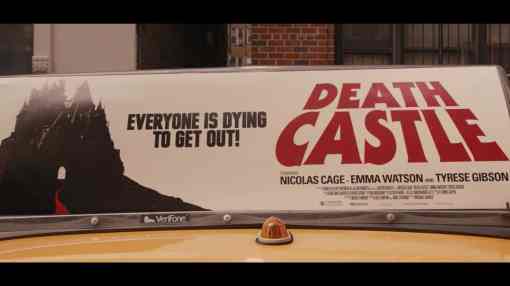
Death-Castle

“I Love You, New York,” episode six of season two of the Netflix show Master of None investigates, while enacting, the dynamics of the turn.

**Spoiler alert! Spoilers abound in this post about spoilers!**

The episode opens with a shot of a taxi cab advertisement for the film (above), then cuts to three friends, Dev, Arnold, and Denise, as they head off to the movie.

Dev: You guys psyched for Death Castle?

Arnold: Oh, yeah, baby. Hear there’s a crazy twist at the end.

Dev: The fuck’d you tell me that for?!

Denise: Yeah, what the hell, Arnold?!

Arnold: What are you talking about? I didn’t tell you what the twist was.

Dev: Yeah, but now I’m going to be expecting a twist.

Denise: For real! Narrative immersion? Ruined!

Arnold: Wow. I hadn’t really considered that perspective on twists. I’m sorry.

Dev: It’s okay, buddy.

The episode then commences to twist wildly. Instead of following the three friends (three of the show’s main characters) as they make their way into their evening and to the movie, the camera follows a nearby doorman and stays with him and his story. For a few minutes. Then, following a fellow doorman to a local grocery store, we begin to follow briefly (again, just a few minutes) the activities of a deaf grocery store clerk. (This portion of the sequence is silent. It’s shocking, at first–I checked the sound on my computer. But then, once I realized what was happening, I settled in for lyric immersion.) The story follows the clerk in some after work activities, until she and her inattentive boyfriend grab a cab. The camera, though, stays on the street, and watches two women hail a cab. This is the taxi the camera takes. Inside, the two women glance at a video screen playing a newscast in the process of wrapping up a movie review of Death Castle. The reviewer states,

The movie may be called Death Castle, but in my opinion it’s filled with a whole lotta life. I say: lower that drawbridge, and get thee to your nearest theater…

The women remark:

Woman 1: Have you seen Death Castle yet?

Woman 2: Yes.

Woman 1: How crazy is that twist?!

Woman 2: I never saw it coming. Wait, so let me make sure I got this right: the black guy was actually Nicholas Cage the whole time.

Woman 1: Yeah, and the castle was heaven.

Woman 2: Yes.

Cut to the taxi driver, shaking his head. The story will now follow him.

Woman 1 (now in the background): I know, it was insane…

Taxi driver [via Bluetooth, speaking to a friend in a language not English, so I’m transcribing the closed caption translations]: God damn it! One of my passengers just ruined the end of Death Castle!

Friend: Don’t say anything! I haven’t seen it yet!

Taxi driver: I hate it when this happens! Cab drivers watch movies, too! They should check if we’ve seen the movie before they start talking about spoilers.

Friend: You still want to go see it this weekend?

Taxi driver: Honestly, I don’t know, man. This kind of ruined my whole day.

The story follows the taxi driver into his personal life as he and his friends spend a night on the town. After meeting a small group of women, someone asks, “Where to now?” And another person asks, “Is there something we can do?” The camera cuts to a theater marquee: “Death Castle‘s playing!”

In the theater, the camera pans (all the while we’re hearing movie dialog in the background confirming the fact that, yes, the two women in the cab did understand Death Castle‘s plot twists): we see members of the group who just entered the theater, and then we see the doorman, and the store clerk and her boyfriend, and then the camera settles on Dev, Denise, and Arnold. As the last of the twist-filled revelations are given, the audience gasps.

Arnold (whispering): What?! What?! What?!

Denise (whispering): Man, I’m straight shook right now!

Dev (whispering): I knew there was a twist, but not like this! This is crazy!

The camera pans left from Dev to reveal he’s sitting next to the taxi driver. Dev lightly bumps him, says, “Sorry.” The taxi driver, sitting with arms crossed, simply shakes his head.

Cut to credits.

“I Love You, New York” is about many things: it’s about race, consumerism, globalism–a fuller reading of the episode (which I’m not attempting here) would have to take all of these elements into account. I just want to, here, admire this episode for its intelligence about the turn. Knowing there’s going to be a twist should never be a problem when encountering narrative or lyric art. Spoiler alert: very, very often, if it’s good art there are going to be turns! Great turning is largely about audience expectations (you can’t give an audience a turn they might think of as tired), and, in order to prevent tired turns, successful turning is mainly about the manner by which the turn is enacted. And finally: pretty much everyone not only loves the kind of Hollywood blockbuster that is Death Castle, but also loves the jolt of surprise that genre supplies. It’s to poetry’s detriment if it doesn’t make use of the turn’s dynamic force.


Turning the Field: The Poetry of Laurie Perry Vaughen

27 06 2017

lpv1

I’ve recently had the exciting experience of encountering the work of poet Laurie Perry Vaughen via the online publication of her master’s thesis, “Artifacts: Selected Poems.” There’s much to admire in the work: its thoughtfulness, its sinewy use of narrative and sound, its palpable imagery. But (of course!) what especially caught my eye was the poet’s attention to the poetic turn. Vaughen made use of Structure & Surprise to help create new work and/or to help articulate (often very movingly) what her work is doing. Very early on in her thesis’s introductory essay (the second section of which is called “Turning the Field: Structure and Surprise”), Vaughen clarifies the distinction between form and structure:

We may approach the field of a poem and immediately see patterns of rhyme scheme, repetition and the footprints of feet. However, many–perhaps most–contemporary poems require a different kind of field work, a deeper read, a deeper turning of the field. Any discussion of my work, of free verse poems, demands a look at the overall movement of the poem rather than noting couplets or beats. A formal poem such as a sonnet, pantoum or villanelle will also offer a structure of movement apart from its form, overall or within a line–if they are mature, polished, rich or ripe.

“Poetic structure is, simply, the pattern of a poem’s turning,” states Michael Theune… (2)

(I really like this idea of poems being “rich, or ripe“!)

Vaughen, though, also is aware of the larger significance and resonances of the act of turning:

Turning as the main movement of a poem is readily identified with nature. Maple leaves turn. Seasons turn. A chrysalis turns to a butterfly. A Jerusalem artichoke turns toward the sun. Evening turns to dusk before turning to morning. Man turns toward death, eventually, as a natural process. As the Catholics finally admitted, the horizon merely turns and the earth turns around the sun, not the other way around. The South African Zulu tribe and the Jew in his or her Diaspora turn to the ancestors for consultation. The structure, the turning in the poem, gives the art pulse, a life blood— and hopefully elevates our resting pulse as we write or read or listen. (6)

(Wow! I love that last sentence!)

Transitioning into her introduction’s third section, “Examining Shards: Emblematic Poems,” Vaughen explains her extra-poetic attraction to the emblem structure, noting, “My poems generally emerge from an emblematic structure. Perhaps this is because I was raised to be an observer of the small within the sublime since childhood and continued this with my undergraduate work in archaeology as an anthropology major” (7).

But, to her credit, for Vaughen poetic structure never ends up being an easy answer for some of poetry’s larger questions. Taking up the issue of increased fragmentation in more recent poetry, Vaughen (in another formulation I greatly admire) states, “There’s no clear answer to…[such] important…concerns about the parts and the whole and the tensions between these. There is a demand on the writer, critic, publisher and reader to explore contemporary poetry with new understandings of how structure, tension as transformation through language can work as synergy” (27). Vaughen then turns to Rilke, who then, in Letters to a Young Poet, “turns the young poet’s attention to nature as the source of synergy” (27). She quotes:

If you will stay close to nature, to its simplicity, to the small things hardly noticeable, those things can unexpectedly become great and immeasurable. No experience was too insignificant – the smallest happening unfolds like destiny. Destiny itself is like a wonderful wide tapestry in which every thread is guided by another thread, and held and carried by a hundred others. (New World Library, 1992 edition: 24)

(Ah! What beautiful weaving Rilke accomplishes even here, even in the rough cloth of prose! It’s no wonder that Vaughen, a maker of so many fine phrases, is drawn to Rilke’s lovely formulation–)

What all of this results in, then, is that while Vaughen still sees structure as a major component of her work, it’s an altered version of structure:

While my poems often hold an emblematic tension or use emblem as a generating pulse that rises to a pattern, the poems are not idea-driven, but language- driven. Lines, enjambment, breaks, stanzas and turns are generated by language, and not a prescribed theme or concrete image. The image serves the language, remember. The emblem I begin with may be a word, a shard of language, which gets associated with another image through sound or syntax rather than symbolic gesture. Though association holds images in tension, sound is also at play. For example, in my poem “Taking Turns,” a secondary turn in the poem’s structure is the language of pedals moving to petals. (36-7)

And, of course, all of this gets enacted in the poetry. Of particular interest:

  • “Taking Turns” (47). A lovely dialectical poem, with a radiant synthesis.
  • “Eye of the Needle” (55). A fine fantasia on sewing and the Christian idea of “passing through the eye of a needle.”
  • “Birds Audubon Never Painted” (58). A brief poem with a stunning arrival point.
  • “Ode to the Faulty Microphone” (80). In fact, a lovely homage to the power of great poetry.
  • “Emblematic,” which begins: “Any metaphor you elevate / has its scarred sense of place–” (81).
  • “After the Tornado” (118). A fascinating (if unintentional) study in endings. I’d thought the poem was a single-page poem–there, it has a tremendous ending, I think. But the poem continues for a half-page. Initially, I was surprised by this: I wondered if that second page should be cut. But the later part of the poem also contributes great power, including fascinating turns, to the poem.
  • “Photograph, 1944” (132-33). An ekphrastic poem that uncovers the image’s seductive, tensive mystery.
  • “Sweet like Funeral Cake” (134). A bittersweet elegy.

I encourage readers of this blog to check out Vaughen’s thesis, and to dive into her poetry. Treasures abound!


Praise for Structure & Surprise

22 06 2017

Villanueva_RA(c-Jennifer Villanueva)

Well, this made my day! In the context of a conversation about rethinking “capital-F Form,” poet R. A. Villanueva has some nice things to say about Structure & Surprise. He calls its title “[a] perfect distillation of what interests me. How to be aware of ‘structure’ in an intuitive and—if it calls for it—an explicit way, while still promising surprise, shock, unsettling.” Music to my ears! Check out his full interview here.

And check out some of Mr. Villanueva’s poetry, such as “When Doves.” Here’s a sonneteer who knows how to wield voltaic power!


John Keats and the Dolphin’s Turn

8 09 2016

Previously on this blog, I’d reflected upon (and praised!) Peter Sack’s notion of the “dolphin’s turn.” As I noted in that post:

According to Sacks, the dolphin’s turn is “a transformative veering from one course to another, a way of being drawn off track to an unexpected destination…”  (Sacks adds: “[T]his turn is paradigmatic for the transportation system of poetry itself, both in its technical “versing,” and in its thematic and figural changes.”)  The dolphin is associated with such turning, of course, because it is a creature that itself is always transgressing boundaries, leaping and diving.

In large part, Sacks’s lecture (which you can listen to here) is an analysis of the dolphin’s turn as it occurs in a variety of poetic works, from the “Homeric Hymn to Pythian Apollo” to poems by Mandelstam, Celan, Bishop, and others.

One poem Sacks did not mention, but which I think deserves mention, is John Keats’s verse epistle to his brother George, and I make my case for my view over at the Keats Letters Project. (You can link directly to it here.)

While you should read Sacks, and perhaps my extension of his thinking, Keats’s verse epistle is required reading for those who love poetic turns. Dive in!


NZ Turn Workshop

7 06 2016

biking-down-mount-bourke-near-wanaka-new-zealand

Gonna be in New Zealand in a coupla days? AND need your turn fix? Then get to this workshop focused on the turn led by Voltage Poetry contributor Joanna Preston–good stuff!


Structure as Pattern of Turning in James G. Hepburn’s Poetic Design: Handbook and Anthology

5 06 2016

When in Poetic Design: Handbook and Anthology, James G. Hepburn uses the word “structure” he means many things: “structure” comprises, among other things, stanzas, syntax, rhyme scheme, and line. However, for Hepburn, “structure” means, primarily, the pattern of a poem’s turning–the thing is, he is not explicit about this, though he should have been.

Right away in chapter 8, “Structure,” it seems as though structure might mean something  like the turn. Hepburn opens the chapter stating, “The structure of a poem is like the structure of a house: it is what underlies, supports, and frames the words, the alliteration, the metaphors, the rhymes. It is the integrated pattern and movement of all the parts” (109).

However, from this focused definition of structure, structure quickly comes to mean a great many things. In the next paragraph, structure means stanzas. Discussing Robert Frost’s “Dust of Snow,” Hepburn states, “The most obvious aspect of structure is the division of the poem into two stanzas” (109). He also notes that syntax is a part of this structure: “But look at the poem again, and observe that the poet has crossed the structure  with another structure: the two stanzas are part of a single sentence” (109-10). Further on, Hepburn adds an additional element to structure: “One aspect of the structure of the poem that has been unmentioned–and there are still others–is the rhyme scheme” (110). And, Hepburn adds, “Of course the individual line is an important structural element in any poem, and a more complete discussion of the two previous poems [“Dust of Snow” and Shakespeare’s sonnet 73] would have dealt with it too” (114).

For all of this range, this diversity, of what structure entails, it is clear that, though he never says it, the heart of structure, as the introduction to the chapter seemed to indicate it could be, is the turn.

The three poems focused on in this chapter feature distinct turns. “Dust of Snow” turns sharply between its two stanzas. Sonnet 73, as one would expect of a Shakespearean sonnet, turns distinctly between the third quatrain and the final couplet. The third poem, William Wordsworth’s “There Was a Boy”, turns profoundly between its two stanzas.

And Hepburn seems to be aware of this: most of his discussions of various structural components entail (though they only imply) the turn, that is, a major shift in the rhetorical and/or dramatic trajectory of a poem. Discussing the two stanzas in “Dust of Snow,” Hepburn notes, “The stanzaic division corresponds with a division between image and idea, or action and reaction: the crow shakes the snow in the first stanza, and the speaker of the poem reflects in the second” (109).

The same thing happens when discussing sonnet 73. Hepburn initially focuses on the rhyme scheme in this poem, noting that this particular sonnet has both a “fourfold structure” (abab-cdcd-efef-gg) and a “twofold structure” (ababcdcdefef–gg) (111). However, Hepburn knows (though he does not say) that the twofold structure pivots on the poem’s turn; he states, “The twofold aspect is supported by the structure of idea in the poem: the first twelve lines say that the speaker of the poem is growing old; the last two lines assert a consequence” (111). In the next paragraph, Hepburn expands on this, and, though he does not say it directly, directs his reader’s attention to the volta:

Now consider another aspect of structure, the development of image and idea. The first four lines present an image of autumn, the next four of a darkening evening, the next four of a dying fire. These three images can be thought of as constituting a single image of a dying fire on an autumn evening, or they can be seen as separate, essentially repeating images. Individually or together, they say: I am growing old. Again, one sees a structure in which the first twelve lines contrast with the last two. The division is further emphasized by the fact that the idea in first twelve lines is presented in sustained images, whereas the ideas in the last two lines is presented more directly. The two parts of the poem look different from each other: in the first twelve lines images are in the foreground, with the idea lying behind them; in the last two lines an idea is in the foreground, served by incidental metaphors. (111)

And the same thing happens with “There Was a Boy.” Of this poem, Hepburn first makes note of its “apparently irregular” structure, commenting on the different sizes of the stanzas (which are so irregular that Hepburn clarifies that each is “more fittingly called a verse paragraph”); on the presence of “several strong caesuras”; and on the facts “that the iambic pentameter rhythm is often broken” and “that there are many run-on lines” (113). Hepburn then turns from this view of the poem to argue for the structural unity of the poem; he states, “He [Wordsworth] does not rely upon a conventional form such as the sonnet, and he does not invent his own neat stanzaic structure; rather, he creates a fluid organic pattern” (113).

Hepburn begins his discussion of this fluid organic pattern by focusing on the poem’s use of line, including the ways that “incongruent grammatical structures” affect it–he notes, for example, that “almost every line in the first verse paragraph is run-on, and almost all the heavy grammatical pauses–ends of clauses and sentences–are placed within the lines rather than at the ends” (114). Hepburn observes that this technique creates “a steady forward movement” that feels “natural rather than sculpted” (114). Hepburn then contrasts the use of these structural elements to their use in the second verse paragraph, which feels “less unified than the first, and lacks something of its forward movement,” thus coming to seem “a diminishing afterthought” (114).

But, of course, this difference in the deployment of structural elements serves to help the poem enact the feelings and moods on either side of the poem’s major turn from lively celebration of wondrous, mystical life to fragmented mourning. As he considers the significance of this (unnamed) turn, Hepburn thinks about how it seems the second verse paragraph could be removed from the poem without too much loss (whereas “Dust of Snow” would be destroyed by the loss of its second stanza), but that in fact this is not the case; Hepburn states, “Yet nothing is more certain than that in its own way Wordsworth’s second verse paragraph is as important structurally as Frost’s” (114). To make his case, Hepburn notes the parallels between the boy’s and the man’s silent listening, and how, only with the second verse paragraph “does the reader himself [sic] stand mute, looking at boy and man in nature, listening to the meaning of life” (114-15).

Hepburn also makes a point that I think is not quite totally correct and that demonstrates a negative consequence of his inattention to the turn; he states,

As a further means of clarifying the structural importance of the second verse paragraph, contrast it now with the quatrains of Shakespeare’s poem. Any one of the quatrains (any one of the images contained by them) could be removed without vitally damaging the structure of the poem or the poem itself: something important would be lost, the clear and sedate narrowing of images and implication, but the poem could sustain the loss, and remain much the same as before. In Wordsworth’s poem the second image of the listening person reverberates against the first, enhances its meaning, gives the poem a direction into deeper meaning. (115)

I disagree with Hepburn’s comparing the second verse paragraph with a sonnet’s quatrain. The second verse paragraph, which comes after the turn, should instead be compared to Shakespeare’s couplet (or, had a different sonnet been used, Petrarch’s sestet). The result is the same: Hepburn still believes that the second verse paragraph cannot be removed. And this is good. However, this paragraph of Hepburn’s would have made much more sense had Hepburn written, “As a further means of clarifying the structural importance of the second verse paragraph, compare it now to the couplet of Shakespeare’s poem. Just as the couplet cannot be removed from that sonnet without irreparably damaging the meaning and significance of the poem, so can the second verse paragraph not be removed from ‘There Was a Boy.'”

The fact that Hepburn does not do this is the sign and seal of the fact that he does not pay adequate attention to the turn in his chapter on structure. He is generally aware of the turn, and his whole chapter on structure pivots on it, but he is not explicit about it, and so some infelicities and confusions arise where there need not be any. The bigger confusion that this partial inattention to the turn creates occurs at the outset of his chapter on structure. Hepburn states that structure is “like the structure of a house: it is what underlies, supports, and frames the words, the alliteration, the metaphors, the rhymes.” So, structure underlies, supports, and frames rhyme, but also rhyme is a structural “aspect” (110). This confusion could have been cleared up had Hepburn differentiated, as did Randall Jarrell in “Levels and Opposites: Structure in Poetry,” between “musical structure” and “other sorts of structure in lyrical poetry.”

In the introduction to How Does a Poem Mean?, the only introduction to poetry textbook that contains a chapter on the turn (though this book refers to it as the “fulcrum”), John Ciardi refers to the book’s final chapter on the turn as “the important one.”  Ciardi clarifies, “The present volume sets out simply to isolate some of the characteristics of poetry and to develop criteria by which parts of the poetic structure may be experienced in a more comprehensive way.  The final chapter suggests a method whereby all the criteria developed in the preceding chapters may be applied to the comprehension of the total poem.”

I think Hepburn agrees. He examines a number of structural characteristics of poems, but the turn is the key aspect of the poem these other characteristics orbit and contribute to. And this is excellent! (In fact, about Wordsworth’s poem Hepburn notes correctly that “[i]t has been impossible to describe the structure without clarifying the meaning, and it would be equally impossible to state the meaning without discussing the structure” (115).) I only wish that Hepburn had been more consistently explicit in articulating the centrality of the turn to his conception of poetic structure. In this way, his treatment of structure would have been more accurate and likely would not have included the small but still unnecessary missteps that it does.


Major Turn A”head”!

25 05 2016

SPOILER ALERT: Major ironic turn a”head”!