Praise for Structure & Surprise

25 01 2013

alvarezphoto

Poet-critic Celia Lisset Alvarez has some very kind words to say about Structure & Surprise over at her blog, “Writing with Celia.”   Among other things, Ms. Alvarez refers to the fact that Structure & Surprise was left off of the Poets & Writers “Best Books for Writers” list as a “glaring omission,” calling it a “dark horse favorite,” and stating that “[f]ull of examples, this book is not only a great read for the poet who is struggling to find ways to guide a poem to the final draft successfully, but also would make a great textbook….any advanced class that is studying poetry, whether creatively or critically, would find this book eye-opening.”

Phew…  What can I say?  Music to my ears.

Especially as this comes from a poet who knows how to engage a turn–just check out Ms. Alvarez’s poem “What It Takes to Be Lois Lane.”


It Is ALIVE!–Introducing Voltage Poetry

1 11 2012

Voltage Poetry…is…alive!!  And you should check it out.  If you like the Structure & Surprise blog, you’re going to love Voltage Poetry.

As noted on Voltage Poetry’s “About” page, in “Lyricism of the Swerve,” Hank Lazer asks, “Is there a describable lyricism of swerving?  For those poems for which the swerve, the turn, the sudden change in direction are integral, can we begin to articulate a precise appreciation?”  Voltage Poetry strives to undertake this important articulation and appreciation.

Co-edited by Kim Addonizio and yours truly, Voltage Poetry is an online anthology that collects essays written by some today’s most exciting poets and critics about poems with great turns them.  Right now, the site features six essays by such luminaries as Kim, Glenis Redmond, Michelle Boisseau, Christina Pugh, Charles Harper Webb, and Annie Finch on some amazing poems by Jean Valentine, Jackie Earley, Mark Jarman, Michael Ryan, Thomas Lux, and Claude McKay.  And each week approximately three new essays will be posted.  As we currently have over 80 contributors, the site’s conversation about the turn will continue to evolve at least for the next six months or so.  However, submissions also are accepted (interested? click here for information)–so the conversation may continue.  In the months to come, I look forward to further reflecting on the turn here at the Structure & Surprise blog by examining ideas and questions raised in and by the essays on Voltage Poetry.  I hope others also may be inspired by Voltage Poetry and begin to think and write more about the poetic turn.

Voltage Poetry has been a collaborative effort from the start.  It has been a deep pleasure to get to work with the site’s contributors–a group of truly amazing poets and critics.  Additionally, many poets whose poems are featured on the site offered gracious assistance when it came to attaining permission to reprint their poems.  And numerous permissions and publishing professionals have been generous and supportive of this project.

It’s been a treat working on this project with Kim–whose energy is unflagging and whose insights and ideas always are revelatory.  Voltage Poetry has benefited greatly from the work–the organization, attentiveness, and care–of our editorial assistant, Amy Fairgrieve, who has done the bulk of the work (from permissions to proofreading) to make the ideas of a poet and a professor take shape and be realized.  Others have assisted, as well.  Student assistants Emily Susina, Al Maiocco, and Erica Kucharski have helped with proofreading.  Consultants Rick Lindquist and Karen Schmidt have helped with technology and copyright issues, respectively.  And Christopher Bray’s photographs have helped to make the site visually striking.  My heartfelt thanks to all involved with this project…

Including you!  Thank you for reading–explore, and enjoy!


Nicholas Royle’s Veering

12 04 2012

“Nowhere is this haphazard and disruptive strangeness of veering perhaps more evident than in the space of literature.  Indeed…in a sense this is what literature is.”  –Nicholas Royle

For those interested in the poetic turn as it is discussed on this blog, Nicholas Royle’s Veering: A Theory of Literature is, for the most part, a real treat: it offers the theoretical surround that helps to show why we need to further highlight the turn in poetry.

Royle’s theory is complex and multi-faceted, and I don’t intend to give a full reading of it here–rather, I want to discuss it a bit generally, and then reflect on its intersections with the thinking about the poetic turn.

According to Royle, his book is “a twisted love story” and “a theory of literature,” but “[m]ostly it is about the love for one word: ‘veering’.”  Royle notes, and then explains: “This word does not occur with enormous frequency, either in literature or in everyday language, but that is perhaps part of its charm.  In the pages that follow I explore ‘veering’ as a sort of pivot for thinking about literature and its relation to the world.”

As one might gather from the above, Royle, who also refers to veering as “a sort of creative and critical, literary and theoretical figure in motion, a dream-shifter,” means many, many things by veering.  At one level, veering is an existential truth; it offers an new orientation to what we are as humans, and to the place that humans possess in the world.  Royle states:

“Veering involves an economy of desire.  Everybody veers in his or her own fashion.  But this is never simply a matter of choice, volition or ‘personal preferences’.   There is always something other about veering.  Veering offers fresh slants on the classical notion of clinamen (‘leaning’, ‘inclination’) as a basis for thinking about the strangeness of life, the singularity of being in the world, as well as about that peculiar thing we call literature.

“Veering is not human, or not only human.  Other animals veer.  So do objects, such as stars.  The theory of veering is non-anthropocentric.  It gets away from the supposition that we human animals are at the centre of ‘our’ environment.  As we will see, the word ‘environment’ has veering–the French verb, virer, ‘to turn’–inscribed within it.  Veering orients us towards a new understanding of ‘the environment’.”

Veering also is a theoretical construct.  Veering offers new ways to read literature:

“Veering is kinetic and dynamic.  At once literal and figurative, it offers a mobile arsenal of images and ideas for thinking differently about literature–about genre, plot and narration, character and point of view, voice, tone and music, authorial attention and desire.  It opens up new possibilities for responding to what is on the move and uncertain in the very moment of reading, to what is slippery, unpredictable and chancy in the experience of literature.”

Much of Veering–including the chapters “Reading a Novel,” “Reading a Poem,” “Veerer: Where Ghosts Live,” “Veerer: Reading Melville’s ‘Bartlebey,'” and “Veering with Lawrence”–is taken up with showing the kinds of insights and perspective one gains from thinking about literature through the clarifying/distorting lens of veering.  Of particular interest is Royle’s development of the concept of the “veerer,” a concept, as Royle himself admits, one “cannot pin down.”  “Veerer,” however, seems to be the name for any instantiation of slipperiness or shiftingness in the text: “Veerer might also be a name for that experience in which you find yourself coming into another track…A veerer…may involve a feeling of uncanny surprise.”  To at least approximate a definition of the slippery veerer, Royle offers fifteen aphorisms to suggest possible meanings/uses of the term; among them:

“1. A veerer is someone or something that veers or makes veer.  You cannot pin down a veerer any more than you can categorize the place of a supplement or finalize the relationship between literature and the secret.”

“4. No aphorism without a veerer.

“12. ‘Veerer’ is at once micrological and macrological.  It might refer, for example, to a movement to be picked up in a single word or piece of a word, or indeed a single item of punctuation or spacing, as well as to an entire text.

“15. The greatest literary works, the most haunting and compelling but also the most resistant to reading, are the most veering.  A masterpiece is always a veerer.”

Veerers can be many things, and vice versa.  Poetic turns, as they are defined in Structure & Surprise and on this blog (as a shift in the rhetorical and/or dramatic trajectory of a poem), certainly are veerers.  Royle often recognizes the relationship between veering and turning:

–“‘Veering’ involves contemplating all sorts of turns, funny and otherwise.”

–“To engage with the verb ‘to veer’ is to find ourselves in Latin, French and other so-called foreign waters.  We are already adrift.  We must turn and turn about.  Besides ‘veer’ itself and other words linked to the French virer, for example, there are all the words related to the Latin verb vertere (‘to turn’)…Then there are the inexhaustible riches of the word ‘turn’ (from the Latin tornare, ‘to turn in a lathe’, from tornus, ‘turner’s wheel’, from Greek tornos, ‘lathe’)…”

–In his brief chapter on drama (“Drama: An Aside”), Royle notes that “[w]hile there’s no veering, in a literal sense, in Shakespeare’s writings…Shakespeare is…the greatest turner in the English language,” and he recognizes that in Shakespeare’s oeuvre “there are hundreds of instances of ‘turn’.”

–“‘A story, to be a story, must have a turning-point’, [Elizabeth Bowen] declares.”

What Royle says about veering also often can be applied to turns; and points that have been made about the turn can be applied to veering:

The turn often creates surprise, as does veering.  Royle states, “Veering can be deliberate or unintentional.  Either way, there is a suggestion of something sudden, unexpected, or unpredictable….Veering, then, entails an experience of untapped and unpredictable energy.”

Considering the turn makes us think about the power and the intrigue of poems in new ways, as does veering.  Royle states, “Veering offers a new and different way of construing the nature of plot and storytelling: changes in subject, narrator, time and location; alterations in characterization, or in a character’s perception, knowledge, belief or feelings; deviation, digression or twisting at the level of the individual sentence, syntax or word.”

Jokes turn from set-up to punch line.  And Royle also recognizes the role of the veer for creating humor: “No humour without veering.”  Aphorisms work in ways similar to jokes, and, was we already know: “No aphorism without a veerer.”

So, turning is a kind of veering, and many of the insights Royle offers about veering can be applied to turning.  I want to turn now offer a few insights into how some of the work done on the turn can help to supplement some of the ideas in Veering.

Those interested in animals veering, and how such veering has influenced / plays itself out in literature, really should read Peter Sacks’s “You Only Guide Me by Surprise”: Poetry and the Dolphin’s Turn.  Sacks reads the presence of dolphins in poetry as totemic, signalling an important turn / veer.  (More detailed information may be found here.)

Royle assigns the veer an important role in evaluating literature, stating, “Veering impels us towards new questions about aesthetics.  A literary text is composed of forces.  It is a work of veering.  The literary work may veer well or beautifully, in a shift or turn that pleases, surprises, thrills, fascinates.  Or it can veer poorly, ineffectually, clumsily.  The ‘twist in the tale’, for example, is hardly ever a veering worthy of the name.”  And the role of the turn in evaluating poetry has been something that I’ve explored on this blog and elsewhere.  Here are a few links:

“Fitting Surprise and the Critique of Recent Poetics.”

“Writing Degree [infinite sign].”  Uses the surprising turn to evaluate contemporary haiku.

“Raising the Net.”  Uses the volta, the sonnet’s turn, to evaluate recent collections of sonnets.  In this essay, I state, “I revise Robert Frost’s idea that writing free verse is like ‘playing tennis with the net down.’  Writing formal sonnets, it turns out, is not too difficult; it’s the writing of sonnets without great turns that’s akin to a netless game.  In contrast, crafting sonnets with an eye toward their turns as well as a critical approach that can account for them not only raises the net but also raises the bar on what we expect from sonnets.”

–Additionally, a panel at the 2012 AWP conference investigated the qualities of excellent turns in short stories.  Read Erin Stalcup’s panel presentation here.
Veering and the poetic turn clearly are related.  However, in one of, for me, the very few disappointments of Veering, Royle does little to make the connection clear.  In fact, when he discusses poetry, Royle tends to avoid discussion of the turn, or else he mentions it to quickly bypass it.  For example, in “Reading a Poem,” Royle discusses diataxis, which he, following Francois Roustang, defines as “the stylistic figure of interpretation that tips discourse over, turns it back, or makes it advance.”  And diataxis clearly is related to the turn; Royle states, “Diataxis is pivotal…for thinking about narrative and dramatic turns–not only the major reversals and returns that characterize the plays of Sophocles or Ibsen and literary narratives from fairy tales to Philip Roth…”  As this sentence’s construction indicates, diataxis as rhetorical turn is about to be overtaken:  “…but also the micrological deviations, digressions or divergences that occur mid-sentence.”  And, when Royle discusses how diataxis can be used to read a poem, he essentially skips the turn; Royle states,

“Above and beyond those characteristics we have just noted…, diataxis in poetry would entail (1) a special attentiveness to the surprising or interruptive play of the letter, the twists and turns a word might take or make, the disjunctive or deviant effects of homonyms or homophones, the strangely mobilized energies of etymology, and so on and sew forth; and (2) everything that is at play in the word ‘verse’ as such, the force of turning that is the very veering of a line, diataxis in and across line-endings.”

At the end of his book, Royle even equates “more specifically poetic veerings” with “the turning of a line or sentence, the turning of a word within itself and between its various appearances.”  The larger-scale poetic turn effectively has disappeared from Royle’s account of poetic veering.

Far from being unique to Royle, this kind of bypassing of the poetic turn, or the elision of the poetic turn into the consideration of verse’s line breaks, is familiar.  It’s the kind of elision one also finds in Jeremy Tambling’s RE:Verse–Turning towards Poetry.  (For my investigation into the way in which Tambling shifts a discussion of the poetic turn to a discussion of verse’s line breaks, click here.)  But just because this kind of elision is familiar does not mean it’s good.

Still, of course, the tasks (not to mention the audiences) of theory often differ from those of poetry criticism and pedagogy.  In Veering, Royle focuses on what he needs to focus on.  And in so doing, Royle develops a fascinating new way to consider all manner of literature and experience, a fascinating new way that, in some very big ways, jibes with the overall project of Structure & Surprise, including this blog.  I hope you’ll check it out.



Helen Vendler: Approaching the Turn

8 06 2011

One of this blog’s key arguments has been that more concerted efforts to differentiate poetic structure and poetic form and to more systematically examine poetic structure would benefit the practices of conceptualizing, reading, writing, and teaching poetry.  (For information on the structure / form distinction, click here.)

I’m not the only one to think this.  Many of those who write poetry textbooks agree.  However, though they agree, their books often fall short of advocating for increased attention to poetic structure, and its attendant turn–and not only to the extent that I hope for but also to the extent that their own texts seem to suggest is proper.

Here, I would like to consider Helen Vendler’s Poems, Poets, Poetry: An Introduction and Anthology.  In this textbook, Vendler maintains the structure / form distinction—though her maintenance of the distinction involves some overlap in terminology—recognizing that, on the one hand, “[a] poem can…be classified according to various aspects of its outer form, having to do with meter, rhyme, and stanza-form” (117) and that, on the other hand, “[b]esides its outer form (“This is a poem in quatrains in falling rhythm rhyming aabb”—a description of Blake’s “Tyger”), every poem has internal structural form” (119).  (Please note that though Vendler’s book is in its third edition, I cite from my copy of the second edition.)

Vendler describes inner structural form as a poem’s “dynamic shape, which derives from the curve traced by the emotions of the poem as they change over its duration” (119).  Though Vendler never uses the word “turn,” this shape clearly concerns a poem’s turning; according to Vendler, “That emotional curve is plotted by connecting two, three, or more points of the poem, a rise from depression to hope to joy, for instance—or a decline from triumph through doubt to despair.  Very few poems represent an unchanging steady state of the same emotion all through” (119).  The emotional trajectory Vendler cites here is a pattern of poetic turning that I call the “Dejection-Elation Structure.”  Additionally, Vendler notes, “In investigating the internal structure of a poem, one should try to divide it into parts along its ‘fault lines.’  Where does the logic of the argument seem to break?  Where does the poem seem to change from first person to second person?  Where does the major change in tense or speech act take place?” (120)  In asking readers to locate a poem’s “fault lines,” Vendler seems to ask readers to identify and track the poem according to its turns.

Vendler then proceeds to offer a cursory list of internal structural forms.  She notes that “[s]ome poems are two-part (binary) poems, like William Wordsworth’s ‘A slumber did my spirit seal’ (which we saw changing from illusion to stern knowledge) or like Dickinson’s ‘The Heart asks Pleasure—first—’ (which we saw changing its conception of God from benevolence to cruelty” (119).  Vendler also notes that “[t]here are also many three-part (ternary) poems, which often take on the internal structure of beginning, modulation, and end (a song-form preserved in lyric),” and, additionally, that “[o]ne well-known internal structure is that of the ‘surprise’ ending, where the last few lines reverse everything that has gone before” (119).  Additionally, according to Vendler, “Internal forms are infinitely variable, since they represent emotional response, always volatile” (119).  Such a list seems like the beginning of the list (constantly under construction) of poetic structures, patterns of poetic turning, located here.

Indeed, for Vendler, mapping a poem’s internal structural form, and an inner structural form very much focused upon the turn, is key to the process she refers to as “Exploring a Poem” (125).  In this process, in which Vendler names a total of 13 elements of the poem for a reader to examine in order to explore a poem—including 1. Meaning; 2. Antecedent Scenario; 3. A Division into Structural Parts; 4. The Climax; 5. The Other Parts; 6. Find the Skeleton; 7. Games the Poet Plays with the Skeleton; 8. Language; 9. Tone; 10. Agency and Speech Acts; 11. Roads Not Taken; 12. Genre, Form, Rhythm; 13. Imagination—at least five have to do very directly with deciphering and determining the poem’s internal structural form: the division into structural parts; the climax; the other parts; find the skeleton; and games the poet plays with the skeleton.  For example, regarding “The Other Parts,” Vendler states, “About each part it is useful to ask how it differs from the other parts.  What is distinctive in it by contrast to the other members of the poem?  Does something shift gears?” (127)  And, regarding “Find the Skeleton,” Vendler essentially instructs readers to decipher the poem’s inner structural form; she asks, “What is the dynamic curve of emotion on which the whole poem is arranged?” (128)

While Vendler’s book does an admirable job of trying to advance structure alongside form, there are, however, problems with this aspect of Vendler’s textbook.  One problem is that it does not advance structure consistently.  “Structure,” or “structural,” means many things to Vendler.   “Inner structural form,” remember, is “dynamic shape, which derives from the curve traced by the emotions of the poem as they change over its duration.”  However, in the section called “Structure,” structure is defined as something more intellectual or logical; Vendler states, “The structures of a poem are the intellectual or logical shapes into which its thoughts are dynamically organized” (82).  Additionally, according to Vendler, one discovers a poem’s structures—according to Vendler, “Any overarching structure can have many substructures” (82)—by looking for patterns, but these patterns are everywhere and on every scale: “Patterns occur at many levels in poetry, just as they do in the physical universe: one can look for patterns in subatomic behavior, in atomic behavior, in molecular behavior, and so on, all the way up to the patterns of the planets and the stars” (83).  And, in the end, structure can be just about anything, including form; Vendler concludes her discussion of “Structure,” stating, “The important thing is to be accustomed to looking, in any poem, at several levels—the sound, the rhythms and rhymes, the grammar, the images, the sentences, the plot, the assertions, the allusions, the self-contradictions.  Somewhere the energy of the poem awaits you.  The moment you see the main and subordinate patterns, you smile, and it ‘all makes sense’” (87).

Another problem with Vendler’s advocacy of structure is that, for however much Vendler recognizes the importance of the non-formal organizational elements of a poem, she tends to give form precedence over these elements, including structure and its turn.  For example, the discussion of “Structure” comes after discussions of both “Rhythm” and “Rhyme”—and a discussion of “Argument” comes even later.  Additionally, in the section called “Classifying Lyric Poems” in the chapter “Describing Poems,” Vendler notes that “[l]yric poems themselves are generally classified in three ways: by content, by speech act, and by outer form” (110).  This, however, also is the section of the book that includes discussion of “Inner Structural Form,” a discussion that, with little commentary, simply gets tacked onto the previous discussion of “Outer Form.”

A final problem—or, perhaps, difficulty—with her advocacy of structure is that, perhaps as a result of the shiftiness of what structure is, Vendler never manages, in my opinion, to be clear about how knowing about structure can deeply inform one’s reading of a poem.  That is, though Vendler suggests that the main pattern, the structure, seems to have a lot to do with major transitions in a poem, how the poem moves, she is not explicit about what a poem’s “main pattern” is.  And, beyond this, there is never any detailed discussion of what the significance of these shapes are, why they are worth examining.  In large part because it never embraces structure and the turn—not even to the extent that I might want it to, but even, only, to the extent that its own discussion of poems suggests that it should—and because it never gets clear on the centrality of the turn for its system, Vendler’s discussions of “structure” and the “structural” tend to be a bit confusing, both offering imprecise or simply too numerous tools for finding structure and not offering enough for people to actually know what they are looking for when looking for structure, or exactly why they are looking for it.

Vendler’s Poems, Poets, Poetry reveals the desire of one major critic to differentiate structure and form.  It also reveals, however, that this desire alone is not quite enough to do the job of significantly differentiating structure and form.  For this, I believe more needs to be done.

I believe we–readers, poets, critics, teachers–have to get very clear in our use of the terms “structure” and “form,” or else things will continue as they so far have, with structure seeming some amorphous, secondary derivative of form.

I believe structure has to be linked to something vital and distinctive—something singular—in poetry, and that is the poetic turn.

I believe that we need to present the turn not only as something that is important in what poems are and how poems work but also as something that—just as form has its own vocabulary and grammar, or, if you will, its own lingo: iambic, trochaic, pentameter, slant rhyme—has its own vocabulary and grammar, its own intricacies.  My reasons for believing this are, on the one hand, substantive—I think that the developing vocabulary and grammar of the turn describes real and significant aspects of poems—and, on the other hand, pragmatic—form may tend to get more attention in our textbooks largely because it has a well-developed terminology, and thus, a more well-developed terminology (beyond Vendler’s cursory list of inner structural forms) may help give structure the attention it deserves.

I believe that, for as much work as the above seems, once this work is done it will greatly open up–and deepen–the conceptualization, reading, writing, and teaching of poems.  What is a poem?  Language that turns.  How do I read a poem?  Track the turns.  How do I write a great poem?  Create language that turns thrillingly.  How do I teach poems?  Take the turn into account.  Of course, these answers are incomplete, but they are vital and new, and I believe such answers will add significantly to the appreciation and creation of, the conversation about, poetry.


Jeremy Tambling’s RE: Verse–Turning towards Poetry

31 05 2011

For years, I’ve thought that an important next step for educating poetry readers about the turn would be to incorporate, and perhaps even highlight, the turn in an introduction to poetry textbook.  So far, this has been done only once, in John Ciardi’s How Does a Poem Mean?  In that book, the final chapter—but also the chapter that Ciardi refers to in his introduction as the most important one—“The Poem in Countermotion” focuses on turns in poems, though Ciardi refers to the turn as the “fulcrum.”  Ciardi’s book, however, was published in 1959—and his focus on the turn was not picked up on by any subsequent introduction to poetry textbooks.

Needless to say, then, I was heartened to see Jeremy Tambling’s RE: Verse—Turning towards Poetry.  The book’s title, at least, indicated that there might be some focus on the turn in the book.  And there is, but, alas, just some.  However, seeing what happens to the turn—how it is both raised as a topic of conversation, and then elided—in RE: Verse can be instructive.

The turn comes up on page one of RE: Verse.  Defining “verse,” Tambling writes,

“[I]t comes from the Latin versus, meaning “a line or row, especially a line of writing (so named from turning to begin another line), verse, from vertere to turn” (Oxford English Dictionary).  Verse means both a line of writing and the turn by which another line is reached, going from line to line.  In English, the turn at the end of the line on the right hand edge of the page means a reverse back to the left.  Verse and reverse: the turn turns back.”

It is important to note here that the turn is an element of the poem’s form.  However, the term “turn” quickly comes to mean other things, as well.  According to Tambling, though it may consist of only one line, Japanese waku can still be thought of as turning, so “you may have to look for the turn inside the one line itself.”  Tambling, however, is not clear how one would find this turn in a one-line poem, and he further complicates his use and sense of the turn when, after having quoted three lines from Paul Muldoon’s “Incantata” (“I thought again of how art may be made, was it was by Andre Derain, / of nothing more than a turn / in the road…”), he notes, “This book starts with the proposition that poetry is always a form of turning, and if for Paul Muldoon it is a “turn in the road,” then the way the poem twists and turns will suggest a very winding path.”  How would a formally twisting and turning poem suggest a very winding path?  Would it slither down the page in the manner of, say, an e.e. cummings poem?

But this is not what Tambling means by the “very winding path” of the poem—virtually all of the poems he cites at length in RE: Verse left-justified.  Tambling, in fact, is interested in helping readers recognize, and recognize the importance of, structural turns in poems.  (For information on the difference between form and structure, click here.)

The first poem Tambling examines closely is William Blake’s “London.”  In a sentence immediately following his observation that “the way the poem twists and turns will suggest a very winding path,” Tambling introduces his discussion of “London” by noting that “[w]riting poetry often plays on this idea of turning.”  And his discussion of the poem, when it focuses on the turn, focuses on the structural turn.  Tambling asks of the poem, “How shall we approach it?”  And his first of a few “hints” he offer is: “[L]ook for the turn: the moment where the poem changes direction, or shape.  (There may be more than one turn, of course.)  Nearly all poetry will have such a turn…”  Tambling also eventually locates the poem’s major turn (notice that there are not 15 turns, as one might expect if turns occurred as one line turned into the next) at the beginning of the fourth stanza, about which he writes: “[S]tarting with “But most” indicates a turn, a new emphasis, something different from the first three stanzas.”

The second poem Tambling examines closely is William Wordsworth’s sonnet “Composed upon Westminster Bridge, September 3, 1802.”  Discussing the sonnet, Tambling, quoting Paul Muldoon’s interview with Lynn Keller, states,

“The sonnet began as an Italian form in the thirteenth century, and the word implies a song.  The Italian, or Petrarchan sonnet, of which this [“Westminster Bridge”] is one, is divided by a pause, or a turn, into eight lines followed by six.  Paul Muldoon, who like many other modern poets, has written many sonnets, speaks in an interview about the “thought process of the sonnet”.  “You establish something and then there’s a slight change”, he says; and he associates this change with “the turn”….”

And speaking of the shift from octave to sestet in “Westminster Bridge,” Tambling states, “We have already noted a break at that point, and when reading poetry, any such turn, change of tone, or of approach, should be noted.”

Tambling clearly believes that knowledge of the structural turn is vital for reading poetry.  However, the attention he pays to the structural turn is less systematic and more sporadic.  In his book’s second chapter, “Five Ideas for Reading,” Tambling offers “five points, or principles, for reading” poetry—but a principle such as “look for turns” is not included in this list.  Even though, it should be added, that there are plenty of poems featuring turns in them that follow Tambling’s list of principles.

Why this assertion and (unintentional, it seems…) denial of the power of the structural turn?  I can only speculate, but I offer a few ideas.

First, it seems as though seeing turns and their importance is not enough.  We need to continue to develop and teach the language, the grammar, of turning.  It’s not that poems simply turn, it’s that, often, they turn in identifiable ways, ways which, once recognized, greatly help one see what’s going on in a poet, or, as Ciardi puts it, how a poem means.

Additionally, we need to think more about the ways that assessment influences what we teach when we teach poems.  Tambling wrote his book with some specific audiences in mind.  While being attentive to the needs of a general reader Tambling has written with a target audience in mind; he states, “I have tried, in writing, to consider the needs of people starting with poetry at GCSE, where anthologies of poetry are frequently set, and people working on specific poets for A Level.  I have tried to work with questions that undergraduates will want to know answers to…”  It could simply be that the exams for which Tambling prepares many of his readers do not concern themselves much with the identification and discussion of turns, so turns, while acknowledged, are not focused on.

Overall, Tambling’s RE: Verse reminds us that we need to revise the ways we discuss and teach poetry.  His good, but also problematic, book reminds us that to talk seriously about structural turns in poetry we have to be ready to allow the turn to let us talk about different poems differently.  We must be willing ourselves to be transformed by the turn.


Surprise!

12 05 2011

I’ve added a new page to the blog: Fitting Surprise.  Atwood, Longenbach, Schopenhauer, and a bunch of others make appearances.  Check it out!


The Quarrelsome Poem

3 09 2010

We make out of the quarrel with others, rhetoric, but of the quarrel with ourselves, poetry.  While William Butler Yeats’s famous formulation is gorgeously and almost convincingly mellifluous, as is the case with so many declarations about poetry in general, it simply is not true: many poems are arguments composed specifically  to quarrel with others.”

So begins my essay, “The Quarrelsome Poem,” just published in Mentor and Muse: Essays from Poets to Poets, edited by Blas Falconer, Beth Martinelli, and Helena Mesa (Carbondale, IL: Southern Illinois University Press, 2010). 

Mentor and Muse is a terrific collection of truly instructive yet delightfully idiosycratic reflections and writing prompts from a diverse group of 29 poets, including Claire Kageyama-Ramakrishnan, Mira Rosenthal, Phillis Levin, A. Van Jordan, Elline Lipkin, Diane Thiel, Nancy Eimers, Maria Melendez, William Olsen, and Kevin Prufer.  It’s an honor to have my own work included with theirs.

In “The Quarrelsome Poem,” I define a kind of structure I call “the cliche-and-critique structure.”  As the name indicates, the cliche-and-critique structure “first reveals a problematic, cliched representation and then turns to provide an alternative to that troublesome, overused language.”

There’s a page on the cliche-and-critique structure on this blog (here) that offers reading supplemental to “The Quarrelsome Poem”; however, the essay in Mentor and Muse goes into much greater detail about the structure, both its demands and the great assistance it can offer a working poet.  Additionally, the essay offers in full the terrific “I Don’t Want to Slam,” by Staceyann Chin, one of the great cliche-and-critique poems, but one not readily available online.  And, of course, as hinted at in my opening to this post: I tried to make my own essay an example of cliche-and-critique writing.

So, check out “The Quarrelsome Poem,” and, of course, the totality of Mentor and Muse…much, much, much good stuff there.


Showing My Work

21 06 2010

Researching for a project I’m working on regarding the ways we value poems (or, more specifically, the ways we avoid talking seriously about what we value in poetry), I looked again at Matthew Zapruder’s “Show Your Work!”

Looking at the comments following Zapruder’s essay, I came across some of my own comments, many of which discuss the turn.  As they’re relevant to what is covered on this blog, and as, in them, I make some significant claims about the power of paying attention to turns, I’ve decided to re-publish a few of them below.  I think these comments have some good ideas in them that can be understood on their own, but I offer a few other comments in order to provide context.  For full context, of course, just click on the above link and read away!

My discussion of the turn was prompted by the following comment:

A thoughtful essay. But what’s missing, I think, is a discussion regarding the influence that K-12 education has on criticism, poetry appreciation, and the writing of poems. Contemporary poetry may be discussed, with some limits, in the college or mfa program, but rarely is it touched thoughtfully in k-12 education. The problem with poetry appreciation and a newer, creative reading of newer works may be that the template for a poem, as was learned by so many of us in our k-12 experience, denies that kind of thing. Many k-12 educators go as far and Langston Hughes, and that’s all.

So anyhow, I lost my train of thought. Here’s my final comment: we need critics who are familiar with not just poetry, but design, music , art and current events so as to coin a new critical language. The new critic should have a strong background in multiple disciplines to be of any use. Then, once their criticism is deemed valuable, the crticism must be published, and not just in jounals, but elsewhere for those who have had a template- experience of the rhymed art.

There’s a problem in marketing that should also be discussed.

Random J

To this I responded:

J,

If I may be so bold (having been emboldened by your recognition of the need for greater marketing for certain kinds of poetry):

I’ve been doing some work to try to create (or, rather, to make clear), to use your phrase, one new “template” for encountering and writing poems, one which provides a way to engage a variety poems, from the canonical and traditional to the avant-garde. My “template” has much less interest in poetry as “rhymed art” but instead considers poems in terms of their structure, the types of turns they take. I think a focus on the poetic turn is one way to potentially spark more interest in poetry, and to show the connections between (seemingly) more accessible poetry and (seemingly) more difficult poetry.

If you’re interested, you can read more on this at my blog…

Best,
Mike

Prompted by a request for more information, I added the followng:

I’m happy to say a few more words about my work with turns.

***

Matthew notes in his essay that “…poets and poetry critics have not done the hard work necessary to explore, refine, and develop whatever terms might help us to even begin to talk about poetry in ways useful to understanding it,” and this, in large part, is a result and a continuation of a situation in which so many of the terms we currently use (such as, as Matthew suggests, “narrative” and “lyric”) “don’t exclude or refine any behavior at all in poetry.” I think that the turn offers a new term (or reintroduces a term) to the conversation about poetry, one which has real potential to shake things up, to change behaviors, both in terms of criticism and pedagogy. I will very briefly sketch out that potential here.

***

In criticism, attention to the turn reveals connections between seemingly disparate kinds of poems and aesthetics. The turn certainly is a feature of “accessible” poetry. A very large percentage of the poems in Billy Collins’s Poetry 180 feature the turn. However, the turn also is a key to the poetics of many “difficult” poets. In “Something of Moment,” her introduction to the issue of Ploughshares she edited (in Winter 2001-02), Jorie Graham argues that “[i]n a poem, one is always given…a stage upon which the urgent act of mind of this particular lyric occasion… ‘takes place,’” thus offering the poem an opportunity to “break.” According to Graham, “All such moments—where we are taken by surprise and asked to react—are marked places in consciousness, places where a ‘turn’ is required.” In fact, Hank Lazer, in “Lyricism of the Swerve: The Poetry of Rae Armantrout” (in American Women Poets in the 21st Century, and in Lyric and Spirit), argues that the turn is a central feature of Armantrout’s poetry.

***

Paying attention to the fact that a lot of poems turn, then, is one way, if one wants, to break down distinctions between established groups of poems. However, paying attention to exquisite, thrilling, truly witty, or sublime turns also offers a way to create new distinctions. There have been (in other discussions, including Reginald Shepherd’s “One State of the Art”) numerous calls for more attention to the poem and not to poets or movements, etc. The turn provides one way to turn the attention to individual, singular poems. And recognizing poems with particularly intriguing turns offers one way to divide oeuvres and schools: some of the poems in any oeuvre or school have turns that are flat and unsurprising, and some have turns that are random, and some have turns that amaze.

***

Such thinking has many applications. (In fact, my current project is writing a book which spells out these applications.) Here, I’ll simply note that attention to the turn has been influential in my own criticism (much of it published in Pleiades). It has offered me a way to combine the jobs of the critic, to argue, at times, that “something is good, or bad,” but it also has allowed me (to some extent) “to write, with focus and clarity, about how the piece of art works, what choices the artist has made, and how that might affect a reader,” but without relying too much on my own personality. (One quick example: in a review of recent haiku, I considered haiku not as a formal unit (5-7-5) but as a structural unit incorporating a turn. Not many of the haiku I reviewed were, in that new light, at all good—no surprises there—but I do think that I also made the value of those few haiku that did have structural intrigue clear. Attention to turns also allowed me to disregard many previous distinctions between haiku—poet, school, etc—and to value individual haiku across the spectrum of poets and schools.)

***

The really substantive application for the turn, however, is in pedagogy, which might be considered enacted criticism. In pedagogy, the turn offers much. The turn is, or easily can be made to seem, familiar to students—everyday language includes all kinds of argumentative, dramatic, and emotional turns; with a little training, students (high school…perhaps junior high?) can see this. Reminded that they themselves in fact are sophisticated language users, students then can recognize and appreciate turns in poems, and perhaps be more ready, able, and willing to apply such recognition and appreciation to not only accessible poetry but also more seemingly difficult poetry. How much better off (college/graduate) poetry classrooms would be if, rather than entering those classes thinking that poems “flow” students instead knew that (lots of) poems “turn”…

***

I’ve gone on way too long. For more info, check out the turn blog…

***

Cheers,
Mike


Eshleman and the Turn

27 05 2010

As a part of some work with a colleague to rethink a particular poetry writing course, I spent a terrific two hours this afternoon sailing through Clayton Eshleman‘s Novices: A Study of Poetic Apprenticeship.  A strange and magical book, I think.

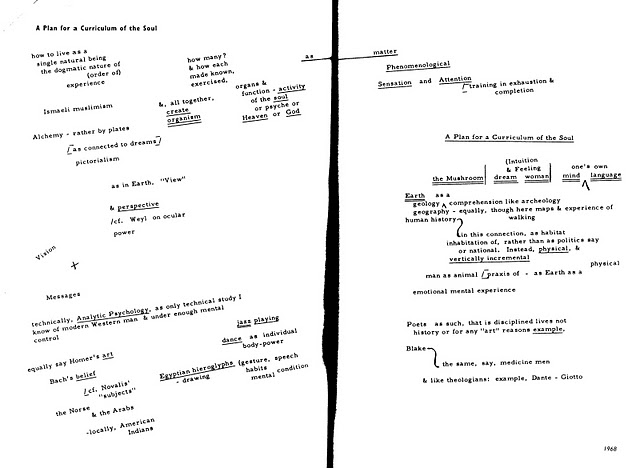
As its subtitle indicates, Novices primarily is an excellent collection of reflections on the fuller demands of poetic apprenticeship.  One of the aspects of the book that I like very much is that it presents some “plans,” “outlines,” and “curricula” for a training in poetry that other poets have suggested, including those by Charles Olson, Gary Snyder, and (though Eshleman is critical of his “daydream College for Bards”) W.H. Auden.  Perhaps my favorite chapter in the book is Chapter 9, in which Eshleman uses Snyder’s “What You Should Know to Be a Poet” as a springboard to launch himself into a discussion of his own theory of apprenticeship, which consists of four “nodes”: “EXPERIENCE,” “RESEARCH,” “SELF-REGULATION,” and “EXPERIMENT.”  Worth looking into.

(Those intrigued by the prospect of thinking more deeply about a fuller poetic apprenticeship might also read H.L. Hix’s “Training for Poets” in As Easy as Lying: Essays on Poetry.)

Of course, though, what also caught my eye (trained on the turn) was a passage from Novices‘ Chapter 7 in which Eshleman emphasizes the role of the turn (or turns) in poems.  He states:

“There is an archetypal poem, and its most ancient design is probably the labyrinth.  One suddenly cuts in, leaving the green world for the apparent stasis and darkness of the cave.  The first words of a poem propose and nose forward toward a confrontation with what the writer is only partially aware of, or may not be prepared to address until it emerges, flushed forth by digressions and meanders.  Poetry twists toward the unknown and seeks to realize something beyond the poet’s initial awareness.  What it seeks to know might be described as the unlimited interiority of its initial impetus.”

Whether a labyrinth or something else, it certainly is true that poetry twists and turns.  While in the process of learning much and cultivating a variety of necessary dispositions and skills, any apprentice to the art of poetry must attend to this aspect of poetry, considering and practicing the art of the turn.


Turning to Blogging Again

27 05 2010

Hi, All,

Turns out, I took some time off from blogging during the academic year…

Well, it’s summertime, so let the new posts begin!

If you’re a new visitor, welcome–  If you’ve visited this blog before, thanks for sticking around–

Cheers!

Mike