SPOILER ALERT: Major ironic turn a”head”!
Check out Ira Sadoff’s “A Few Surprising Turns”–if you read this blog, you just might like to read this poem…!
Anthony Wilson analyzes the twists and turns of Tony Hoagland’s poem “Medicine” here. Check it out!

“Let us like a poem to an internal combustion engine. It is mounted, or housed, inside a sturdy frame. The structure must be sturdy because the contents of the poem are combustible; the vibrations are fierce.”
So, just a few days ago I published a post on James Longenbach’s “Lyric Knowledge,” an odd essay that goes a great distance to say something simple but vital: that the organization of a poem is significant. Longenbach goes so far as to reorder some poems to show the effect of organization, and especially to reveal the achievement of the originals. In that blog post, I argue that though he doesn’t come right out to say it, one of Longenbach’s great concerns in his essay is the vital poetic turn. When he reorders the poems under his consideration, Longenbach destroys the power and the beauty of the original poems’ turns. He then argues that the poems were fine–even great–just as they were.
Interestingly, today I read another essay that performs the same kind of critical act (reorganizing a poem) and agrees about the importance of poetic organization and the turn–though, very much like Longenbach’s, it doesn’t exactly come right out and declare its admiration for the turn. This essay is Tony Hoagland’s “Poetic Housing: Shifting Parts & Changing Wholes” (The Writer’s Chronicle 45.5 (March/April 2013): 90-99).
Here is my argument that chief among Hoagland’s concerns in fact is the turn:
1. Almost right away (in the second paragraph), Hoagland establishes the structure-form distinction: he will not be discussing form but some other aspect of poetry:
This constant threat of imbalance, of eruption, or potential amorphousness is especially present in the writing of free verse poetry. The sonneteer or a writer of villanelles has at least a pre-ordained form to fill–to tell her roughly where the poem’s beginning, middle, and end belong. But the free verse poet is always wondering about structure–guessing where the end of the poem might be, trying to detect what optimal dramatic shape might be emerging. (90-91)
2. What Hoagland means by “structure” is not something amorphous, but rather is “dramatic shape.” The next paragraphs after the one quoted above state:
The reason concise dramatic shape is important, even in “loose” associative poems, is because poems are pressurized containers. A poem must contain energy; that is, hold it in. You can’t carry water in a colander. And in order for the poem to contain, accumulate, and release pressure it must have shape, a dramatic progression.
Housing and Transmission: Let us liken a poem to an internal combustion engine. It is mounted, or housed, inside a sturdy frame. The structure must be sturdy because the contents of the poem are combustible; the vibrations are fierce. The housing contains and directs the explosive force of combustion with precision.
I know that these principles apply to fiction and nonfiction as well as poetry. But structure is an especially crucial issue in poems. Why? Because poems have so few words, and, given the small space they occupy, the relative proportion and relation of words to each other can change very fast. Suddenly, the theme turns out to be different than expected, or an image appears which is so resonant, it becomes indisputably structural. (91)
3. When Hoagland sums up “the whole of the poem-reading experience,” he states that there are “two general by useful assertions”:
Here, before turning to clinch my case, I want to pause for a moment to argue that the turn is one of the most primary moments a poem has. It certainly is the case that poet-critic John Ciardi thinks this. I make the case about this here.*
And I think poet-critic Jane Hirshfield also would agree. As I argue here, Hirshfield refers to the turn as a “window-moment.” As I note in that earlier, linked-to blog entry, “Though Hirshfield notes that such window-moments may be momentary elements within a poem, most often the window-moment is associated with the turn.** In my blog post about Hirshfield’s notion of the “window-moment,” I note, “The relation between the window-moment and the turn is made even clearer when one considers that many of the poems Hirshfield discusses in her essay have major turns, turns which often are equated with the window-moment.” And the same can be said not only of Hirshfield, but also of Ciardi (for whom all fulcrums really are principal turns), and Hoagland.
The poem that Hoagland attends to most closely is Jean Follain’s “The Art of War.” This twelve-line poem is largely a list. It begins, “At the window a rose / the color of a blonde’s young nipple / a mole walks underground,” and then includes two other image clusters: “Peace they say to a dog / whose life is short. / The air remains full of sunlight.” It concludes with one longer item: “Young men / learn how to make war / in order to redeem / a whole world they are told / but they still find the book / of theory unreadable.”
About this poem, Hoagland argues,
If…we were to identify the internal dominant moment of “The Art of War,” we would choose the complex final sentence, identifiable by size, grammatical momentum, and complexity, with its many turns and developments….Follain’s poem has a loose structure, and Follain’s work in general is the quintessence of the associative mode, which is to say, the relationships between its parts are largely inferential. Little is explicit, yet this last sentence in “The Art of War” carries much of the intelligence of the poem. It is a sequence in which, as the sentence unfolds across line breaks, a chunk at a time, we watch the poem’s emphasis and stance complicate and shift….We apprehend it all in a second; our cognitive process is swift, nimble, and resourceful at recognizing and adjusting the parameters of the poem, determining what is the essence of the poem, the housing. Every other inflection of the poem turns upon that structural recognition. (my emphasis)
Opening with six lines of largely paratactic listing that then accumulate in six lines of hypotactic conclusion, this brief poem is the kind of poem that Longenbach seems especially taken by in “Lyric Knowledge,” in which Longenbach investigates the same kind of paratactic-hypotactic turn in the first section of Wallace Stevens’s “The Auroras of Autumn.” And Hoagland treats this poem in a way similar to the way Longenbach treats the section from Stevens: he rearranges it in order to show, ultimately, the power of the original.
Hoagland creates a poem, called “Why I Grow Flowers,” which reshuffles “The Art of War.” “Why I Grow Flowers” begins with the sunlight, then moves to the mole, then the young men (minus the book of theory), then the dog image, and it concludes with the window-rose-nipple image cluster. About this poem Hoagland states,
This rebuilt poem has quite a different thrust. This version emphasizes the pleasures of peace, and seems to infer some sound reasons for applying for conscientious objector status. After all, it concludes with palpable arguments for peace: a flower garden and the promise of erotic adventure. In its favor, this revision is distinctly more unified than the original. Yet, unfortunately, it is a less dynamic and less interesting poem. Loose as it still is, and not without nuance, this version is a lesser poem. (94-95)
I couldn’t agree more with Hoagland’s assessment. Great poems rarely offer simple unity. Rather, they offer dynamic shifts and surprises. As Randall Jarrell notes in “Levels and Opposites: Structure in Poetry,” “A successful poem starts from one position and ends at a very different one, often a contradictory or opposite one; yet there has been no break in the unity of the poem.” (I also tend to agree with his critique, later in his essay, of the “elliptical mode,” a mode which, according to Hoagland, can be much too tolerant of structures so loose that they have no center, no key turns, at all, offering instead “only the mystique of mystification.”)
Much like Longenbach’s “Lyric Knowledge,” Hoagland’s “Poetic Housing” is important reading for anyone interested in the poetic turn–it’s full of great insights. However, as readers of this blog know, I look forward to a day when discussion of the turn is not quite so deeply and variously encoded and embedded (as housing, fulcrum, window-moment, center, torque, or swerve) and is acknowledged more explicitly as the vital feature of poetic significance- and experience-making that it is.
—
*I offer the following paragraph from the linked-to blog post as a glimpse of that larger argument:
The importance of the turn is clear in Ciardi’s book. Though Ciardi discusses the turn in the last chapter of How Does a Poem Mean?, “The Poem in Countermotion,” this chapter is the ultimate chapter, the chapter which Ciardi in his introduction calls “the important one.” Additionally, Ciardi states, “The present volume sets out simply to isolate some of the characteristics of poetry and to develop criteria by which parts of the poetic structure may be experienced in a more comprehensive way. The final chapter suggests a method whereby all the criteria developed in the preceding chapters may be applied to the comprehension of the total poem.”
Ciardi even differentiates between “principal” and “lesser” fulcrums (“fulcrum” is the term Ciardi uses for the turn). A poem’s major turn or turns are primary moments, indeed.
**Here’s a glimpse at what Hirshfield says, which supports my belief that a window-moment really is a turn:
In the swerve into some new possibility of mind, a poem with a window stops to look elsewhere, drawing on something outside of its self-constructed domain and walls. A window can be held by a change of sense realms or a switch of rhetorical strategy, can be framed by a turn of grammar or ethical stance, can be sawn open by an overt statement or slipped in almost unseen. Whether large or small, what I am calling a window is recognized primarily by the experience of expansion it brings: the poem’s nature is changed because its scope has become larger.
Check it out here–!
At first glance, James Longenbach’s “Lyric Knowledge” is an incredibly odd and, so, perhaps weirdly intriguing, essay. It begins in a seemingly interesting way: it’s opening line states, “The impulse to be lyrical is driven by the need to be no longer constrained by oneself.” Whoa. Okay. It seems, as the whole introductory paragraph–about suffering, love, the familiar, novelty, experience–indicates, we’re entering some strange, new territory. But what follows such an opening turns out to be pretty standard stuff–stuff which, in fact, is only interesting for how obvious it is.
Or so it seems. Here, I want to explore “Lyric Knowledge” and suggest that this convoluted essay really is about some incredibly plain but incredibly potent truths about lyric poetry, truths that have been discussed repeatedly in Structure & Surprise, and in this, it’s accompanying blog. But I’ll then speculate on some reasons why a critic such as Longenbach might work to keep such plain truths mysterious.
Here is the key idea of “Lyric Knowledge,” which is subtitled “Ideas of order in poetry”: poems offer a different kind of readerly experience when read out of the order in which they are written. That is–to be clear (yes, you did just read correctly what I wrote): again and again in this essay, Longenbach takes poems, restructures them–sometimes putting the final few lines first; sometimes reversing the whole text (with a few, necessary syntactical adjustments) so that what was the final line goes first; what was the penultimate line goes second; what was the third-to-last line goes third; etc–and then claims amazement at the fact that the two texts create different experiences for readers.
For example, Longenbach takes an epigram inscribed, according to Plato’s Phaedrus, on Midas’s tomb, mixes up the lines (1, 2, 3, and 4 become 3, 2, 4, and 1), and then is kind of blown away by the fact that the two poems don’t have the same effect. He states,
In this version we discover in the final line that the poem is spoken by a bronze statue of a girl, eerily similar to any girl who might have received Midas’s amorous attentions; in the original version our experience of the poem is predicated on this knowledge. What does the fact that one can alter significantly the effect of a poem without changing a single word tell us about the power of structure? What did Socrates [earlier quoted as having said of this epigram “that it is of no consequence what order these lines are spoken in”] not want to recognize about that power?
He treats similarly the concluding fourteen lines of Wallace Stevens’s “No Possum, No Sop, No Taters” and “Western Wind.” To focus just on “Western Wind,” Longenbach takes that four-line poem and switches it around so that the final two lines become the first two lines; so that this:
Western wind, when will you blow?
The small rain down can rain.
Christ, if my love were in my arms
And I in my bed again.
becomes this:
Christ, if my love were in my arms
And I in my bed again.
Western wind, when will you blow?
The small rain down can rain.
While I probably should simply celebrate Longenbach’s work here–after all, it is largely a recognition of the importance of poetic structure (and, as I’ll demonstrate later on, I mean structure as I’ve long meant structure: as the pattern of a poem’s turning)–I can’t quite get over the fact that what is so odd about this work is how much labor is spent to make such a painfully obvious point. Small changes make big differences in great writing–that’s one of the main ways we know it’s great writing. Big changes make really big differences. It is shocking that the bulk of an essay in Poetry is spent re-making such palpable points.
*
At least, initially. When we get clear on some key details, this fact turns out to be not so surprising at all.
Here are the key details:
Longenbach really is concerned with poetic structure–that is, he is concerned with the pattern of a poem’s turning, a poem’s rhetorical and/or dramatic trajectory. At different points throughout the essay, Longenbach notes how what he is pointing to are turns. For example, reflecting on the two versions of “Western Wind”–noting about his alternative version that “while the form of the poem is unchanged (alternating tetrameter and trimeter lines, rhymed xaxa), its structure has been radically altered”–Longenbach states, “Here [that is, in his alternative version], we turn from an experience of longing to the weather, an external drama that confirms the emotional turmoil. Something happens in this shift from interiority to exteriority [that is, in both versions], for we feel in both arenas the power of absence, the desire for change, but something more momentous happens in the original structure, in which our expectations are not confirmed but shattered.”
Longenbach isn’t the only critic interested in turns. Of course, I am. But so are the editors are Poetry. (Here is some proof.) So are, frankly, just about all critics and editors. However, most critics and editors do a lackluster–and certainly, overall, an unsystematic–job of acknowledging how much they admire well-executed turns. Longenbach’s essay is guilty of this, as well–it is enthralled by strong turns, but it doesn’t articulate this well.
More specifically, Longenbach is concerned with a particular kind of turn: one that ends up leading to what I have called “fitting surprise.” (This kind of turn is, indeed, special; many critics and commentators have been intrigued by fitting surprise–check out a constantly growing collection of quotations on the topic here.) In “Lyric Knowledge,” Longenbach’s interest in fitting surprise emerges most clearly when he discusses the first section of Wallace Stevens’s “The Auroras of Autumn.” Longenbach notes that in this section, the poem moves from a great deal of paratactic syntax to, in its third-to-last and penultimate sentences, to some key uses of hypotactic syntax–as Longenbach notes, “‘This is his poison: that we should disbelieve / Even that.’ This is the first sentence that thrusts our thinking forward by suggesting that one thing follows from another not merely by chance, association, or accretion but by necessity (‘His poison is that we should disbelieve even in happiness’).” Just as with “Western Wind,” the effect of rearranging the poem serves mainly to highlight how well-constructed the original version is:
It is not surprising that, without altering a single word, this lyric reads as elegantly backward as it reads forward, the form unchanged (iambic pentameter lines arranged in tercets) but the structure radically different: ‘The moving grass, the Indian in his glade, / Black beaded on the rock, the flecked animal / Made us no less sure.’ But deft as this arrangement may be, its structure sacrifices the crucially delayed turn from parataxis to hypotaxis, a turn that makes the figure of the Indian, when it finally appears at the end of the poem, feel simultaneously unprecedented and inevitable. The poem is a dramatization of the thinking mind in the process of discovering that thought itself is the mind’s most indomitable foe. ‘Here are too many mirrors for misery,’ says the final lyric in the sequence, and the work of ‘The Auroras of Autumn’ is to make this simple remark feel authentic, to allow us to exist in the temporal process of discovering it again.
“[U]nprecedented and inevitable.” There is in fact some precedent for Longenbach prizing such poetic effect. In “Composed Wonder,” the final chapter of The Resistance to Poetry he recognizes the power of this effect in Anthony Hecht’s “‘It Out-Herods Herod. Pray You, Avoid It.” Longenbach writes,
And though by the end of the poem we have become quite used to the aural pleasure of these rhymes, something astonishing happens in the final quatrain: the content of its last line…is potentially overpowering. Nothing in the preceding eight stanzas prepares us for it, and even if the Holocaust seems in retrospect to be everywhere in “‘It Out-Herods Herod. Pray You, Avoid It,'” the poem’s final lines continue to surprise. When we hear the first half of the final stanza…we are fully prepared for the aural experience of the stanza clicking into place with a rhyme on “childermas.” We don’t necessarily expect the poem to jump to a new register…, but the expected rhyme makes the leap seem horribly inevitable. (99-100)
And, as I note in my critique of The Resistance to Poetry, “This standard is hinted at elsewhere in the book,” and that elsewhere is particularly interesting: “Longenbach employs the language of structured surprise to express his admiration for one of the oldest poems in the English language, ‘Western Wind.’ About that poem…Longenbach states, ‘The expostulation—Christ!—marks the place where the poem breaks open, releasing an emotion that is both unpredictable and, at least in retrospect, logical.'”
*
And so, Longenbach has created another work–this time, an essay–that suggests the deep importance of great, unique turns. Indeed, he even goes back to cover in greater detail a poem, “Western Wind,” that he thinks has fitting surprise, and then, essentially, closes “Lyric Knowledge” with another poem–or section of a poem, the first section of “The Auroras of Autumn”–that he thinks also has fitting surprise. It’s clear that Longenbach admires these kinds of turns. But if he does, why doesn’t he do more with them? Why isn’t he more explicit and articulate about this feature of great poems?
In my critique of The Resistance to Poetry I argue that Longenbach does what he does because he understands that if he were to really prize fitting surprise he would have to do away with other ideas about poetry that he values. I note, for example, how valorizing the poetry of fitting surprise would put to the test other valorizations of poetry Longenbach was trying to promote:
[Fitting surprise] can be used to draw party lines in new ways. Putting all weight and pressure on the poem, it doesn’t make judgments according to poets or schools. Wet disjunction [the kind of disjunction used by a poet such as T. S. Eliot, which Longenbach valorizes] might create structured surprise, but so might dry [the kind of disjunction used by a poet such as Ezra Pound, which Longenbach does not valorize]. Ashbery might have twenty poems that do this, but so might a lesser-known poet—and such a fact should encourage us to get to know those works of that lesser-known poet. In fact, what Longenbach says of Bishop’s expectation that art lead to “perfectly useless concentration,” that it “makes the hard work of art seem simultaneously rare and available to everyone,” can also be said of structured surprise.
It is more difficult to tell what Longenbach is doing with fitting surprise in “Lyric Knowledge.” At one level, Longenbach again generally uses fitting surprise just as many other critics before him have: sporadically, acknowledging its great power, but without an effort to try to spell out, let alone act upon, how valuing fitting surprise might really and interestingly upset longstanding valuations of and distinctions in poetry. At a slightly different level, this odd essay–in which he seems mystified by the fairly obvious fact that (unlike, say, a “paragraph from a blog or a parking ticket”) some poems, reread and reread, keep enchanting us–powered in part by fitting surprise affords Longenbach opportunities to subtly reinscribe some of his old favorite distinctions (parataxis successfully transmuted into hypotaxis corresponds to his valorization of wet disjunction over dry).
At another level, though, Longenbach’s sporadic use of fitting surprise allows him to sidestep a key issue: what makes poems powerful and memorable? Longenbach has set up a kind of either-or, combined with a straw man: either some text (such as a parking ticket) is weak and unmemorable or else it strong and memorable due to fitting surprise. But, of course, there’s a huge amount of middle space Longenbach does not investigate. What about a cheesy favorite song one loves to hear again and again for nostalgic reasons, for the associations the song conjures rather than, say, the structure of the lyrics? What about a note announcing a break-up? Language has power and is memorable–and yet is returned to again and again–for a host of reasons, not necessarily because a text in some way delivers fitting surprise. Longenbach takes a shortcut with his essay, avoiding discussing these other kinds of texts.
But here’s the thing: whenever fitting surprise–be it in the form of a poem or a short story or a joke or a play–is delivered, you do indeed know you’re in the realm of powerful, moving–and it is tempting here to say specifically literary–language. (NB: even as I write this, I realize how much more deeply I still have to think about this…) Longenbach uses a shortcut, but it is, to some extent, legitimate: after all, Longenbach is trying to demonstrate the importance of structure in great lyric poetry, and he clearly believes (and I certainly agree) that fitting surprise is a vital part of great lyric poetry. I hope Longenbach might start saying so more clearly and systematically.
A switch can be a sensory detail that socks a reader. It can be a sound that echoes long after the reader has put the book down. Or it can be a “turn” in structure that sparks an insight no reader could have predicted. In his essay “Poetic Structure and Poetic Form: A Necessary Differentiation,” Michael Theune defines the turn as “a significant shift in the poem’s rhetorical progress.” In other words, the poem’s line of thought shifts into new territory. Theune goes on to discuss how a poem’s structure can facilitate these turns. And “structure” should not be seen as a scary word, for it “is more than logic; it organizes and encourages a poem’s leaps and landings, it arrives at places at once prepared-for yet seemingly unexpected.”
Preparing for the unexpected. You, poet, should be surprised by your own work. And you can work toward those surprises.
–Tania Runyan, How to Write a Poem: Based on the Billy Collins Poem “Introduction to Poetry”
What a treat, to find thinking about the turn making its way more generally into the teaching of poetry–terrific!
Fitting, that it occur in a book inspired by Collins’s “Introduction to Poetry,” a poem, like so many of Collins’s poems, focused on skillful turning. Fitting, too, that it is featured in a book by Tania Runyan, a poet who regularly deploys vital turns in her own work–check out the significant and complex turning in her poem “The Bee Box.”
As part of the programming for the inauguration of Illinois Wesleyan University’s nineteenth president, Eric Jensen, on Friday, April 1, some colleagues and I participated in a series of lightning talks highlighting some of the artistic and scholarly projects taking place at IWU. Along with poet Dan Smart (among other things, the author of the great poetry blog “Rhythm Is the Instrument”) and student respondents Kristina Dehlin and Jake Morris, I was a part of the presentation “High Voltage Poetry: On the Poetic Turn.” Check it out for a succinct introduction to the turn, for Dan’s terrific reflections on ways in which the turn has informed his own work, and for Kristina’s and Jake’s very smart reflections and questions–
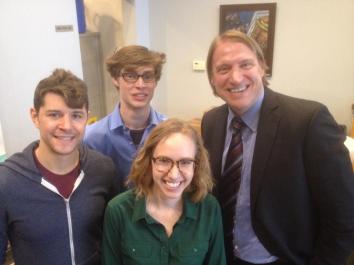
The High Voltage Poetry Team: Dan Smart, Jake Morris, Kristina Dehlin, and Mike Theune
Structure and Surprise
If—the facts
are all
plot—and
the plot, simply details,
and if
words are just hollow magic
tricks to make the wind more
reliable and appear more
solid than it really is,
and—what if?
even our bravest
intentions
to be totally
literary—only
are shards?
of some shattered shared
soul of a soundless-in-vast-perpetuity universe,
which moves forever
toward frozen oblivion,
without ever really changing shape—
Then what?—what’s left? in the
landscape, I wonder,
to survey.
I see—only
epiphany!—crumbling
architecture, yes,
but some
pretty
cool gargoyles leftover.
*
How could it be that I failed to share this?!
The above is a poem by friend and fellow student Dan Smart, who is publishing the products of his amazing, multi-year, poem/day project over at his blog, Rhythm Is the Instrument. “Structure and Surprise” is just one of (holy $#!+) over a thousand poems, and like so many of ’em, it, among many other things, loves and plays with turns. Enjoy! (And then do check out Dan’s blog for many, MANY more great poems and turns–)

Over at Assay: A Journal for Nonfiction Studies, Diana Wilson has published “Laces in the Corset: Structures of Poetry and Prose that Bind the Lyric Essay”, an essay that uses poetic structures to examine the movements in a number of lyric essays. Wilson uses the emblem structure to read Richard Selzer’s lyric essay “The Knife”; the retrospective-prospective structure to read Brian Doyle’s lyric essay “Leap”; the ironic structure for Robin Hemley’s “Twirl/Run”; and the elegiac structure for Lia Purpura’s “Autopsy Report.”
In her penultimate paragraph, Wilson notes:
I often think of the lyric essay as a mysterious sea creature, its structure hydrostatic, like a jellyfish that appears, to the casual observer, to be nonexistent. The lyric essay, a subgenre of creative nonfiction, is a wild thing born of poetry and prose, the prose sentences appearing to wave and dance willy-nilly like tentacles of jellyfish while poetic elements flicker and flash through the sentences like neon luminescence. Only careful study reveals the muscular structure that propels the lyric essay forward.
I love this insight: that by carefully attending to structure’s turn we can see how the lovely, odd creature that is the lyric essay moves.
I love, too, that Wilson has begun to find broader application for thinking about and with the poetic turn. I’ve long thought that one of the turn’s attractions is the way in more closely connects poetry and prose–how completely appropriate, then, to employ the turn to examine and think more deeply about the lyric essay’s prose poetry.
According to her author’s note, “Laces in the Corset” is Diana Wilson’s first publication. My thanks, then, to Ms. Wilson for taking the time and effort at the start of her publishing career to consider so carefully, and use so creatively, the turn. I look forward to seeing how her thinking and writing continues to develop–develop and turn…!
 Structure & Surprise