The Turn on the Air

23 06 2009

MakingofaSonnetPbk

In a previous post, I discussed Edward Hirsch and Eavan Boland’s The Making of a Sonnet: A Norton Anthology, both praising it and thinking about the ways in which this anthology both privileged the turn in the sonnet but also noting some of the ways this anthology did not quite give the turn its full due.

What a pleasure it was, then, to listen to “The Making of Sonnets,” a show on WBUR’s “On Point,” with Tom Ashbrook, originally broadcast April 1, 2008, and re-broadcast today, June 22, 2009.  Mainly, it was just a pleasure to get to hear Hirsch and Boland read and discuss numerous great sonnets.  However, it also was a pleasure to get to hear a discussion about a central tradition of English poetry that really and truly foregrounds the turn.

Responding to Ashbrook’s request for “a little definition: what’s a sonnet?,” Hirsch responds by noting that, while sonnets are generally difficult to pin down, they can best be considered “a fourteen-line poem, in main, with a structure that turns.”  The early part of this interview,then, especially, pays a lot of attention to the turn in sonnets.

A terrific interview, for a variety of reasons.  Well worth listening to for all those interested in poetry, even moreso for those interested in sonnets, and perhaps even moreso for those intrigued by the feature of the turn in sonnets.  Needless to say, I highly recommend it.


The Self-Reflexive Turn

22 06 2009

turnsign

I’ve added a new page to the Theory & Criticism portion of this blog.  It’s called “The Self-Reflexive Turn,” and it contains poems that not only have turns in them but draw attention to those turns by, in fact, calling them “turns.”  Here are two of the new page’s poems:

“Sonnet,” by Bernadette Mayer

“In this strange labyrinth, how shall I turn?,” by Lady Mary Wroth

Interesting in themselves, I think, such self-reflexiveness also offers further evidence of the degree to which poets are aware of the importance of the turn in poems.  Check out the new page–and let me know of other poems that employ self-reflexive mention of the turn.


Learning Structure from Dante

11 06 2009

dante

Paying attention to poetic structure, to the patterns of signficant turns in poems, is not by any means new–for a long time, thinking about poetic structure and turns has been a key feature in numerous significant discussions about poetry and types of poetry.  It is in large part this fact that makes the present-day tendency toward a lack of discussion of structure so noteworthy, and so clearly in need of redress.  Thus, a little book report on one of the great, earlier discussions of poetic structure: Dante’s La Vita Nuova.

La Vita Nuova is an anthology Dante created out of many of his own shorter poems.  The poems are interspersed among an ongoing prose commentary that has two main features.  The first is an account of the actual events which gave rise to the poems–essentially, the trajectory of Dante’s relationship with his great love, Beatrice.  The second (and the feature I want to focus on here) is an analysis of the poems.

Throughout his commentary, Dante discusses how his poems work, but what’s fascinating is how he does this: Dante consistently breaks his poems down into their “parts” to reveal the structure of his poems.  For example, considering his sonnet “To every captive soul and gentle lover,” Dante writes, “This sonnet is divided into two parts.  In the first I extend a greeting and ask for a reply; in the second I convey what it is that requires a reply.  The second part begins: Already of these hours…”  Elsewhere, Dante not only divides his poems into parts but also shows how the parts themselves can be subdivided.

For Dante the awareness of the parts, the divisions, of a poem is key to understanding the meaning of that poem.  At the conclusion of his analysis of his canzone “Ladies who know by insight what love is…” Dante states, “Certainly to uncover still more meaning in this canzone it would be necessary to divide it more minutely; but if anyone has not the wit to understand it with the help of the divisions already made he had best leave it alone.  Indeed I am afraid that I may have conveyed its meaning to too many by dividing it even as I have done, if it should come to the ears of too many.”

But why does Dante undertake, over and over again, this particular kind of structural analysis?

In her introduction to her translation of La Vita Nuova (the Penguin Classics edition; New York: Penguin, 1969), Barbara Reynolds suggests that Dante is trying to instruct readers who are acquainted and preoccupied with the features of poetic form as to how to read his poems more vitally and accurately.  Reynolds states, “What is interesting is that [Dante] evidently thinks it necessary to make clear to fellow-poets and instructed readers where the counter-divisions occur.  Perhaps he considered that preoccupation with the form of poetry or with its embellishments was tending to obscure lucidity of thought.”  Reynolds pursues this thinking:

“These severely arid analyses of poems…are really an invitation by Dante to enter his study and stand beside him while he runs a finger down the parchment page of his manuscript.  ‘Look,’ he seems to be saying, ‘here is a canzone.  You know, of course, how a canzone is constructed metrically, consisting of a sequence of identical stanzas, each stanza being composed of a frons, which is divided into two pedes, and a sirima, which is divided into two voltae.  What I want you to notice is the articulation of the thought-content, for this is by no means always identical with the structural [i.e., formal] articulation…'”

That is, according to Reynolds, Dante is thinking about poems in a way that anticipates, and prefigures (by over 600 years), a similar discussion about poetry: Randall Jarrell’s “Levels and Opposites: Structure in Poetry,” one of the great essays on poetic structure, and an essay Jarrell introduces by stating, “I shall have to disregard the musical structure of poetry: metre, stanza-form, rhyme, alliteration, quantity, and so on.  I neglect these without too much regret: criticism has paid them an altogether disproportionate amount of attention….I am going to talk, primarily, about other sorts of structure in lyrical poetry.”  And, of course, Jarrell’s distinction between the musical structure [the form] of poetry and the other structures of poetry is a distinction that anticipated, prefigured, and inspired the structure-form distinction at the heart of the undertaking that is Structure & Surprise.

Fascinating to think, though, that issues very similar to those thought about in Structure & Surprise also were of concern to and being thought about by Dante some 700 years ago…

*

One additional note.  Even though it’s clear that structure is a vital component of poetry, not everyone likes the kind of analysis; as  Barbara Reynolds notes, “Some readers resent and may skip those sections of the commentary in which Dante indicates the divisions of the poems, feeling such matter-of-fact analysis to be an intrusion into the dream-world of ecstatic love which is conjured up by the consecrated tone of the rest of the work.  It is said, for instance, that Dante Gabriel Rossetti, through whose translation of the Vita Nova Dante and Beatrice became part of the pre-Raphaelite movement, so disliked the paragraphs in which the poems are analysed that he could not bear to translate them and had to ask his brother, William, to undertake this part of the task for him.”  Certainly, the analysis of the sections of, the turns in, a poem isn’t exactly sexy, rapturous work; however, it is, I think, a necessary part of a fuller engagement with a text, an engagement that encourages a more encompassing understanding of and feeling for how a poem moves and creates its affect.  And so, it is simply necessary to keep drawing attention to this aspect of engagement with poems, especially when it seems that this aspect is being overlooked in the conversation about poetry–whenever it is that such overlooking occurs.


A Speaker(1)-Speaker(2) Structure (?)

30 05 2009

kidman

(Spoiler Alert: If you’ve not yet seen the movies The Sixth Sense, The Others, and Fight Club, 1) you should, and 2) you might want to skip this post til you do–some secrets vital to these movies are revealed below.)

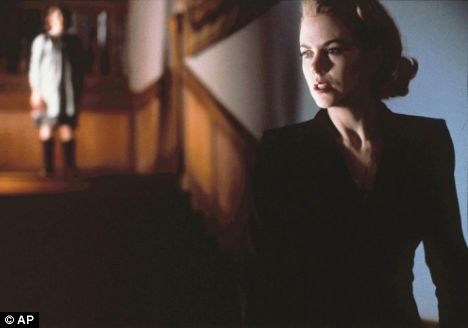
We see it often in the movies: the characters we think we know turn out to be radically different from what we had thought.  In The Sixth Sense, Dr. Malcolm Crowe (the child psychologist played by Bruce Willis) turns out to be a ghost.  In The Others, Grace Stewart (the mother played by Nicole Kidman) also turns out to be a ghost.  In Fight Club, the narrator (played by Edward Norton) turns out to be Tyler Durden (played by Brad Pitt).

And so, prompted by some comments from Avi Akshoti over at the Structure & Surprise “Welcome!” page (thank you, Avi!), I gotta ask: are there poems that employ this kind of turn?  That is, are there poems in which the person you thought was the speaker turns out to be someone else entirely?

Now, of course, a lot of poems record a substantial change in a speaker–just check out the Dejection-Elation Structure or the Descriptive-Meditative Structure, or read Coleridge’s “This Lime-Tree Bower, My Prison,” a poem that combines these two structures beautifully, recording the speaker’s transition from despondency to joyfullness.

But this isn’t what Avi was, and now I am, asking for: what we want to know is: are there poems with speakers who turn out, in a surprising turn as radical as that found it The Sixth SenseThe Others, and Fight Club, to be radically different from what we expected?  If so, what are these poems?  (Please DO feel free to reply.)  If not, 1) write one and send it in, or else 2) theorize why this kind of poem has not been written.

The closest I can get to this kind of poem is Margaret Atwood’s “This Is a Photograph of Me,” a poem in which the speaker turns out to be dead…

Other ideas?


(Re:)Arranging Poetry Writing Classes

12 05 2009

I’ve recently read, with great interest, Tom C. Hunley’s Teaching Poetry Writing: A Five-Canon Approach (Multilingual Matters Ltd., 2007).  My interest in this book is twofold: 1) I’m personally attracted to the alternative pedagogical system the book espouses, and 2) I think Hunley’s ideas in this book jibe nicely with an effort to incorporate greater focus on poetic structure and turns into poetry writing classes.

The big idea of Teaching Poetry Writing (TPW) is simple: we need to replace a largely ineffective workshop model in our poetry writing classes with what Hunley calls the “five-canon model.”  TPW’s first chapter (the title of which, “It Doesn’t Work for Me: A Critique of the Workshop Approach to Teaching Poetry Writing and a Suggestion for Revision,” says it all) largely is a critique of the workshop model, arguing, “The workshop model was not designed with undergraduates or the ruck of graduate students in mind.  It was designed for gifted, elite writers who needed very little instruction, though they may have benefited from criticism on their manuscripts.”  Knowing that it is not enough to simply critique the workshop model without offering another model which might replace it, Hunley suggests organizing a poetry writing class around the five canons of rhetoric: invention, arrangement, style, memory, and delivery.  That is, according to Hunley, poetry writing classes need to devote much more time to in-class prewriting activities, collaborations, formal play and stylistic imitations, and to the memorization and performing of poems.  (Workshopping and the offering of detailed, specific critiques, according to Hunley, can best be handled in conferences and online, employing instructional technologies such as Blackboard.)

I agree wholeheartedly with Hunley’s take on the need to replace the workshop model.  And I agree very largely with Hunley’s pointing teachers in the direction of an alternative method like the five-canon model.  My own experiences teaching undergraduate poetry writing have confirmed how ineffective the workshop model tends to be, and so I have taken steps in my own teaching to try something new.  Interestingly, my own choices largely have coincided with much of what Hunley suggests.  For example, I now do a LOT in terms of sharing invention strategies with students, and allowing students to practice some of those strategies in class.  And very often I match text-generating invention strategies with a poetic form to help students consider the methods with and by which they might craft their poems.  In fact, one of the big goals of my pedagogy is to get students to see that one very fruitful way to conceive of the task of the poet is to conceive of the poet as someone who gives her/himself creative assignments and then works to complete those assignments.  The pay-off for this kind of approach is immediate: students bring better work and thinking to the drafts of their poems, so, when we actually do discuss them, the drafts generally already are working in some big, vital ways.  (So far, I have not done much with memorization and delivery in the poetry writing class; however, I do teach a literature class called “Poetry through Performance,” and through the experience of teaching that course I know what a powerful pedagogical technique the performance of poetry can be—encouraged by Hunley’s writing, I will certainly consider employing this methodology in my poetry writing classes.)

TPW strikes me as offering something vital for poetry writing pedagogy now—anyone starting to teach poetry writing or beginning to re-think their own poetry writing pedagogy should carefully attend to it.  TPW does the massive work of suggesting the need for a paradigm shift in poetry writing pedagogy, and it does the vital detail work of offering a lot of specific guidance in terms of how to pull off such a shift: specific exercises, specific technologies, specific texts.

Although not mentioned in TPW (perhaps because the books were published in the same year), I think Structure & Surprise, along with many of the other poetry writing books cited and referenced by Hunley, offers many insights applicable to teaching using the five-canon approach.

S&S is most applicable to the second canon, arrangement.  Citing Covino and Jolliffe’s Rhetoric: Concepts, Definitions, Boundaries (Allyn & Bacon, 1995), Hunley notes, “Arrangement occurs in rhetoric when ‘the arguments devised through invention are placed in the most effective order.’  It is ‘the art of ordering the material in a text so that it is most appropriate for the needs of the audience and the purpose the text is designed to accomplish.’”  According to Hunley (who cites the Encyclopedia of Rhetoric and Composition), “Rhetoric’s second canon, arrangement…is ‘the art of dividing a discourse into its parts and the inclusion, omission, or ordering of those parts according to the rhetor’s needs and situation and constraints of the chosen genre.’  The least written about of the five canons, arrangement has always been a sort of neglected middle child, rarely stealing the spotlight away from invention and style, its attention-grabbing siblings on either side.”

Although structure is touched on in a section of TPW called “Arrangement in the Rhetorical Tradition” (in which it is noted, “In classical rhetoric, orators traditionally arranged their speeches into five parts: exordium, narratio, confirmatio, refutatio, peroratio”) and in some of the “Practical Classroom Applications” that grow out of this section, the methods for arranging the content of a poem offered in TPW focus mainly on poetic form, as is indicated by the section title “Arranging Poetry in the Verse Mode: Traditional Forms.”  Additionally, the section called “Arranging Poetry in the Prose Mode: Free Verse” also is largely about form, focusing on kinds of poetic lines and line breaks.  This is, of course, fitting: for a long time now, form has seemed generally to be the way to arrange poems, and form of course offers powerful tools for such arrangement.  However, I’d simply add that poetic structure, attention to the patterns of turns in poems, offers a significant additional way to think about the arrangement of poems, its own practical pedagogical applications (see this blog’s “Pedagogy” page for links to this developing conversation), and a reminder: non-formal arrangement is not only a concern primarily for rhetors but also for poets, who for a long time (Eliot calls the turn “one of the most important means of poetic effect since Homer”) have arranged poems—both formal and free—around turns.

With Teaching Poetry Writing, Tom Hunley has given me a name for what I do (or am trying to do) in my poetry writing classes, and he has given me lots of new information and methods for my teaching.  Perhaps, for others interested in Hunley’s approach to teaching poetry writing, Structure & Surprise (and this blog) can serve as a kind of supplement to the pedagogical model presented in Teaching Poetry Writing, offering helpful ways to think about and to teach another key means of arranging poems: poetic structure, the pattern of turning in poems.


OKD and the DMS

5 05 2009

olena-kalytiak-davis

In “The Lyric ‘I’ Drives to Pick up Her Children from School: A Poem in the Postconfessional Mode,” Olena Kalytiak Davis includes as a key drama in that poem the unsuccessful effort to give significant shape to the scattered movements of her mind, movements which themselves struggle to reflect (upon) the fragmented state of the life they try to depict.

To convey this drama, Davis incorporates (about half-way through) in her largely associative poem an extended summary of the descriptive-meditative structure, as it is spelled out in M.H. Abrams’s “Structure and Style in the Greater Romantic Lyric.”  Davis quotes heavily from the same part of Abrams’s essay that Corey Marks uses to summarize the descriptive-meditative structure in his chapter on the descriptive-meditative structure in Structure & Surprise:

“The speaker begins with a description of the landscape; an aspect or change of aspect in the landscape evokes a varied but integral process of memory, thought, anticipation, and feeling which remains closely intervolved with the outer scene.  In the course of this meditation the lyric speaker achieves an insight, faces up to a tragic loss, comes to a moral decision, or resolves an emotional problem.  Often the poem rounds upon itself to end where it began, at the outer scene, but with an altered mood and deepened understanding which is the result of the intervening meditation.”

Though, elsewhere, Davis clearly and actively employs the descriptive-meditative structure in her poetry (Structure & Surprise includes Davis’s “Resolutions in a Parked Car” in the “Supplemental Poems” section of the chapter on the descriptive-meditative structure), in “The Lyric ‘I’ Drives…” Davis employs a reference to that structure in order to note how that structure “evades her [or, rather, the poem’s “lyric ‘i'”].”  With this reference to the descriptive-meditative structure (which aims at insight, decisiveness, resolution), Davis is able to highlight the forlorn (if occasionally lively, witty) quality of the experiences and the thoughts her poem attempts to convey.

This seems a fascinating use of reference to a structure in a poem.  It is a bold and powerful gesture to say, in effect, I know where I’m supposed to go with this, but to do so would not be truthful to the content of my experiences or my thinking.  However, such a gesture is not totally unfamiliar.  It is, in its own way, a kind of concessionary gesture, one that acknowledges, I know what I should be doing, but I cannot, and/or will not…  And poems often comment on the structural expectations they feel they are evading or revising.  For example, many elegies often acknowledge that they should be aiming at finding some consolation only to admit (or bemoan) that consolation eludes them, or else actively critique the effort to find consolation.

None of this is a critique of Davis’s poem.  Rather, it is only to make note of a significant reference to structure in poetry, and to draw some further attention to a new use of a time-honored (though perhaps little-known) poetic technique.  Additionally, it is to offer one detail regarding the method by which, as Ira Sadoff says in “The True and Untrue Confessions of Olena Kalytiak Davis,” Davis “accounts for the structure of the poem” even though she structures her poem “associatively.”


Students Don’t Like Poetry? Teach Turns

26 04 2009


thunderstorm2


In “Why Students Don’t Like Poetry,” a Chronicle of Higher Education blog post from April 19, 2009, Mark Bauerlein argues that students don’t like poetry largely because they are introduced to the wrong kind of poetry: difficult poetry by the likes of John Ashbery, the kind of poetry it’s hard to understand “the basic meaning” of, poetry to which students “can’t relate.”


According to Bauerlein, when he “tried a different kind of verse, this one with rhyme and regularity and narrative,” the students took to the poetry.  The poem Bauerlein uses as an example of more student-friendly work is Dana Gioia’s “Summer Storm.”  According to Bauerlein, Gioia’s poem worked in the classroom because it “had rhyme and music,” and because it “had a subject they [the students] all could understand…”


While Bauerlein’s post gave rise to many interesting comments (especially by teachers telling about what they’ve done in the classroom to convey to students the pleasures and the discipline of poetry), many of the comments also are predictably polemical.  Some say Bauerlein is right on: poetry should be accessible.  Others argue that he is dumbing-down the real demand of difficult poetry merely to appeal to a generally uninformed audience.


Now, I don’t want to say that applying the turn to this conversation would offer a kind of cure-all for teaching poetry, but I do think that some judicious thinking about the turn can offer some helpful insights and ideas about and for pedagogy.


Thinking about the turn is called for in this case.  While Gioia’s “Summer Storm” does have “rhyme and regularity and narrative” it also has a clear and distinct turn: at the beginning of the third-to-last stanza, the poem turns from a memory to a consideration of the meaning of memory and the past.  However, as so often occurs in poems with turns, the turn goes by unrecognized as a significant feature in the poem.  (In fact, though he includes a link to the full text of Gioia’s poem, Bauerlein’s citations and summary of the poem include nothing of the poem after the turn.)


But, of course, I think the turn should have been mentioned.  Mentioning the turn is simply descriptively accurate: the poem in fact has a turn.  And the turn could have been one of the things the students liked and “got” about Gioia’s poem: Gioia’s poem offers something accessible to many 19 year olds: a story with a moral.


But focusing more attention on the turn could have offered even more to the conversation.  If not a cure-all, the turn at least could build bridges, including:


1) from the student’s own language to the poem’s maneuvering (students use turns in their own language; they easily can be shown how poems employ turns);


2) from a focus on a poem’s meaning to its being—showing students that poems are things that turn is one of the clearest and most succinct ways to show students that poems are more enactments and less easily-paraphrased statements; and


3) from accessible to more difficult poetry—aware that one of the key things that poems do is turn, students become better readers of all kinds of poems.  (The turn is at the heart of not only so many of the poems in Billy Collins’s Poetry 180: A Turning Back to Poetry but also the poetics of Rae Armantrout and Jorie Graham.  (For a glance at the turn’s presence in Armantrout and Graham, click here.  Scroll down to read the quotations from Jorie Graham and Hank Lazer on Rae Armantrout.))


While Bauerlein’s choice of Gioia as an alternative to Ashbery is polemically fraught, raising specters of the ol’ American poetry wars, and in fact might depend on those old dichotomies (intentionally or not, it pits New Formalism against the Post Avant, and suggests that one way you figure out if a poem is accessible is if it rhymes), focusing on the turn could help to erase those dichotomies: what about teaching some (accessible?) poems that have clear and distinct, easily spotted and discussed turns and then teaching some (difficult?) poems that incorporate more complex movements, twists and turns that the students could work to map out and work through?  In this way, the turn can be used to link seemingly different kinds of poetry rather than contribute once again to problematic and predictable binaries.


Structure & Surprise: Recommended for Geniuses

22 04 2009

OrdinaryGenius_Presentation030608.indd


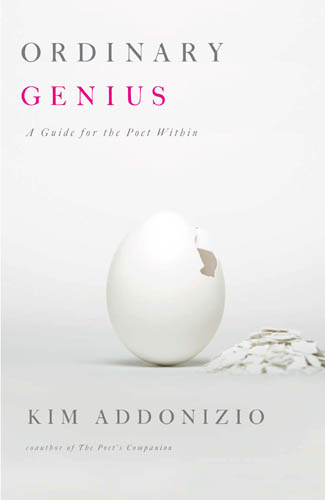
Cool news: Structure & Surprise is listed in the “Recommended Reading” section of Kim Addonizio’s new guide to poetry writing, Ordinary Genius.

For some time, Kim has been a supporter of Structure & Surprise, recommending it on her web site, but it’s terrific to get this kind of additional recognition.  Thank you, Kim–cheers!


The Build-and-Activate Structure

13 04 2009

canisminor


I’ve added a new page to the “Pedagogy” section of this blog: “The Build-and-Activate Structure.”  Below is the content of that page (links are inserted on the page):

In “Inspiration, Guides, Exercises,” the final section of Structure & Surprise, I offer the following suggestion to help generate a poem:


“Invent a new kind of turn by taking your writing further than it might usually go….[W]rite a poem in which you construct a fantastic object or machine, a magical mechanism called ‘The Desire Vaporizer’ or ‘The Memory Box.’  Employ lots of odd, specific details.  At the end of the poem, turn the machine on and say what happens.  Of course, it could be interesting if nothing, or something very unexpected, happens.  If so, you may have a draft of a poem employing the ironic structure.”


Here, I’d like to provide an example of a poem which employs just such a turn from building to activation.  It is, in fact, the poem that inspired me to write the above suggestion.  Here it is:


Scale Model of Childhood


Who can say what calls me to work

these late hours

by lamplight and magnifying glass?


After the ladybug

retracts its long,

knife-point wings beneath its red shell,


I use the brush of one hair

to connect the black stars

stippled on its back:


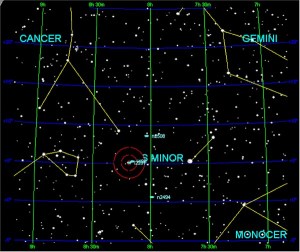
Canis Minor,

who licks its teeth,

muzzle still red with Acteon’s blood,


Canis Minor,

waiting at the feet of the Twins

for crumbs to fall from their table.


In another room,

my parents sleep lightly,

never dreaming,


mouths open

as though ready always

to call my name.


When my constellation is finished,

I pierce it with a pin,

my little dog,


and place it

in a miniature box,

size of my thumbnail,


a window for the shoe box diorama

I assemble each night

from tidbits no one will miss.


When I was a child

feral dogs ran the woods

beyond our door.


Even the hound my father shot

slipped away by morning,

a line of blood pocking the snow.


My parents instructed me,

never stray outside.

Nights, my back on the bed


and my head tilted back,

I watched stars scroll past

my narrow window’s frame.


Once I thought I’d step from childhood

as from a doorway

into a night blazing with stars


so numerous

they defied constellation.

I’d stride into the revealed world


away from the house

and my parents framed by a window

as they sat at a table


holding forks

with no morsels pierced

near parted lips.


Pull the lever on the side of the box

and their forks will scrape

empty plates


while an unseen dog

howls for its dinner

in an almost human voice.


—Corey Marks


From Renunciation (Urbana, IL: University of Illinois, 2000).  Reprinted by permission of the author.


In “Inspiration, Guides, Exercises,” I suggest that poetic structures can be used by working poets in many ways: from inspiration, to drafting, to revision.  “Scale Model of Childhood” seems to me to offer a really inspiring structure for poets and for teachers of poetry, one that has a lot of creative and pedagogical potential, but one which (largely because turns have not been a systematic part of our discussions of poetry and poetry writing) has yet to be as widely employed as it can (and perhaps should) be.


A few notes on this poem:


First, I have included “The Build-and-Activate Structure” in this blog’s “Pedagogy” section and not in “New Structures” because I’m reserving “New Structures” for structures which have been more widely employed.  (If there are other build-and-activate poems out there, please do let me know.)


Second, note that while the turn from construction to activation is vital in “Scale Model of Childhood,” it is not the only poem’s only turn.  The construction section has many important turns in it, as well (including from construction to the sleeping parents to the maker’s ideas of what he thought his childhood would lead to…).  If you’re going to try to make your own “build-and-activate” poem, consider employing some smaller turns within your own “build” section.


Third, note that if you like this poem by Corey (who is, among many other things, the author of the chapter on “The Descriptive-Meditative Structure” in Structure & Surprise), you might like to read his poem “Portrait of a Child,” which I’ve included on the page in this blog which I call “Voltage!,” a page that features poems that take particularly thrilling turns.  And if you like these poems, of course, check out Corey’s book Renunciation.  That is, after you write your own “build-and-activate” poem.


Maureen N. McLane’s “Twisting and Turning”

30 03 2009

3043870616_07e166c04b

The turn is so rarely discussed in the conversation about contemporary American poetry that it’s always worth noting when the turn in fact does come up in that conversation.

The latest issue of American Poet (36 (Spring 2009)) contains one such new discussion: Maureen N. McLane’s “Twisting and Turning.”  This essay, subtitled “A Divagation Prompted by the Poets Forum Panel of November 8, 2008,” is a kind of round-up or encapsulation of the panel on “Twisting and Turning” (a panel featuring McLane, Ron Padgett, Robert Pinsky, Kay Ryan, and Susan Stewart) at the Academy of American Poets’ Poets Forum in New York.

On the one hand, there truly is much to like about this essay.  It draws attention to the turn, giving a feel for the great range of ideas and perspectives that must have arisen during the panel discussion.  And, more specifically, the essay offers some very good information; for example, it points to some poems that not only make turns but also refer to turns or the action of turning.  These poems include William Wordsworth’s “Surprised by joy…,” Frank Bidart’s “The Yoke,” and Bernadette Mayer’s “First turn to me….”  “Twisting and Turning” is a very good, occasional essay, worth the attention of anyone interested in the poetic turn.

However, on the other hand, the essay also shares a somewhat problematic trait with some other discussions of the turn: when discussed too broadly the turn, in fact, becomes too diffuse to be considered the active part of poems it really is.  For example, McLane writes:

“One could, of course, explore poetic turns at multiple levels: morphemic, lexical, phrasal, tropological, conceptual, structural, generic, transmedial.  We might consider how poetry turns away from or turns toward their various inheritances; how bilingual or multilingual poets turn their poems through various linguistic and semantic and cultural grids.  From a certain vantage, of course, there is nothing that is not a turn in poetry: The very word verse comes from versus, ‘turn’ in Latin.”

Of course, it certainly is the case that, defined so broadly, turns are everywhere in poetry, and that all of the issues and components in and among poems that McLane says are turns might in fact be labeled turns.  The problem with this, however, is that, defined this way, the turn, which is meant to mean so much, loses all of its specific meaning.  For example, directly following the above quote, the turn turns into one more discussion of form; McLane writes:

“(Let us defer for another essay the question of whether poetry = verse: obviously it doesn’t!  Or rather, let’s concede that the equation of poetry and verse has been vexed in English-language poetries for some two hundred years [see Wordsworth, even before Baudelaire].  Nevertheless.)”

“Twisting and Turning” begins by referencing the sonnet’s turn, which McLane calls “only the most conspicuous example of the formal and cognitive turns a poem may enact.”  But then it leaps out to consider, or rather mention, all the various kinds of turns there could potentially be in a poem, and the turn comes to mean everything, even formal verse.  However, while such a move is theoretically justifiable (and, indeed, very likely was necessitated by the essay’s drive to include a variety of perspectives and takes on the turn), it should be noted that this leap also leaps over much of the detailed work there is to do to think about and bring to light the kinds of turning specifically focused on in Structure & Surprise, the kind of rhetorical and dramatic turn that T.S. Eliot calls “one of the most important means of poetic effect since Homer.”

As I discuss in my own American Poet essay, we need to try to be more specific when it comes to defining and discussing turns.  I think we more fully give the turn its due when we consider as a turn the structural turns featured in so many poems.  Somewhat paradoxically, this limits the conversation about turns, but in this way it also focuses and concentrates the conversation, making it potentially even more helpful and productive: in this way we can, for example, see that there are specific (if under-discussed) trends and traditions in terms of how poems turn, and we can appreciate poems for the ways they deploy and invent their structural twists and turns.  In this way, the turn becomes a truly well-known quantity, an unavoidable one, one which then can be further problematized and investigated.

Kudos to Maureen McLane for a lively discussion of the turn, one which gives anyone interested in turns much to appreciate and to think over.