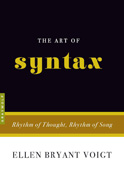
The sonnet’s volta, or “turn”…has become an inherent expectation for most short lyric poems.
–Ellen Bryant Voigt, The Art of Syntax: Rhythm of Thought, Rhythm of Song
The sonnet’s volta, or “turn”…has become an inherent expectation for most short lyric poems.
–Ellen Bryant Voigt, The Art of Syntax: Rhythm of Thought, Rhythm of Song

I’ve just added a link to John Keats’s sonnet “Bright Star” to the Cliche-and-Critique Structure page. A lovely poem–check it out!

In a recent post, I cite a terrific paragraph from Arthur Plotnik’s Spunk & Bite. That paragraph, titled “Surprisingly Apt,” reads:
“Ultimately, the devices of surprise may set up the pins, but they don’t guarantee the strike. The essence of surprise is in its timing and execution: fast, graceful, and apt. Aptness is paramount. The best surprise of all may be how precisely an unexpected word or image pops a message. Unexpected is easy; unexpectedly perfect helps separate writers from hacks.”
As I note in that post, what I like so much about this paragraph is that it jibes with a quality of writing that I’m very taken by: a quality I call “fitting surprise,” that moment in writing when something occurs that is both unexpected and yet truly apt. “Fitting surprise” is not a kind of turn, but rather a quality of turn I value highly.
For those (potentially) interested in this quality of turn, I thought I’d highlight an essay I wrote a few years back that offers my clearest statement about what I think fitting surprise is: “Writing Degree ∞ (on Recent Haiku).”
While generally a review of some recent haiku, “Writing Degree ∞” also offers some history of the concept of fitting surprise (for example, how it is discussed by artists, writers, and critics such as Lee Gurga, Rene Magritte, Pierre Reverdy, Barbara Herrnstein Smith, Margaret Atwood, Antonya Nelson, and Randall Jarrell) and employs the concept critically, showing how the application of the concept actually can make a difference in how one thinks about, in this instance, haiku. (I suggest that the more structural quality of fitting surprise should trump formal considerations when trying to determine what are successful (or: awesome, astounding, wonderful…) haiku–haiku form (three lines of 5, 7, and 5 syllables, respectively) offers very little in terms of how to judge the success of a haiku (anyone can write a 5-7-5 haiku!) whereas the mysterious, difficult, and amazing quality of fitting surprise offers a worthy criterion: if one detects the presence of fitting surprise in a haiku, that haiku is doing something powerful, something singular.)
Please note that while I hope all of “Writing Degree ∞” is worth paying attention to, the essay’s turn to discussing fitting surprise and its role in the evaluation of haiku begins with the final paragraph on p. 150.

I’ve included two new poems on the Metaphor-to-Meaning page:
“The Hen,” by Zbigniew Herbert
“Ted’s Head,” by Rod Smith
They’re pretty ironic, as well–good fun…check ’em out!
My recent reading–both for re-thinking some of my writing pedagogy and the avoidance of such thinking–revealed some very interesting ideas about surprise and the structural nature of comedy.

Considering new texts for my first-year writing course (“S.W.A.T.: Sass, Wit, and Text”), I examined Spunk & Bite: A Writer’s Guide to Bold, Contemporary Style, by Arthur Plotnik, and I found this in a section of the book called “Freshness: The Wallop of the New,” in a chapter called “The Pleasures of Surprise”:
“Readers love surprise. They love it when a sentence heads one way and jerks another. They love the boing of a jack-in-the-box word. They adore images that trot by like a unicorn in pajamas.
“Why does surprise please us? Think of it as a survival mechanism: Unexpected stimuli exercise the neurons, keeping brains alert to danger, prey, and available taxis. In fact, a recent study suggests that brains prefer surprise to the expected….
“But enough anthroposemiotic musing! Everyone knows that good writing stimulates readers with inspired, sneaky surprises. It does so at all levels, from surprises based on twists of plot and character to the smaller but keen surprises of language–the ones that concern us here.
“Is there a syntax of surprise, a formula for working it into our locutions? Yes and no. Surprise is like one of its vehicles: humor. Try to parse it, and it’s hasta la vista, bubela. Yet even humor yields an occasional secret to those who won’t let it alone….”
Of course, in agreement with Plotnik, the work in Structure & Surprise and on this blog has been, in part, to reveal that surprise does yield many of its secrets, does have a syntax (or structure) at those other levels. (For my first-year writing class, in order to teach about those other, larger structures, I will use They Say/I Say, a book that jibes in very interesting ways with structural thinking, and especially The Cliche-and-Critique Structure.) However, I’ve also tried to make a distinction between structure and plot. (For this, see my blog post Against “Narrative”.) Not a big issue, and certainly no critique of Plotnik’s book, which I’ve decided to use as a style guide for my first-year writing course.
Though Plotnik had me at “surprise,” at the end of “The Pleasures of Surprise,” in a paragraph labeled “Surprisingly Apt,” Plotnik sealed the deal, writing,
“Ultimately, the devices of surprise may set up the pins, but they don’t guarantee the strike. The essence of surprise is in its timing and execution: fast, graceful, and apt. Aptness is paramount. The best surprise of all may be how precisely an unexpected word or image pops a message. Unexpected is easy; unexpectedly perfect helps separate writers from hacks.”
I couldn’t agree more. For some time, I’ve been interested in what I’ve come to call “fitting surprise,” that moment in writing when something occurs that is both unexpected and yet truly apt. “Fitting surprise” is not a kind of turn, but rather a quality of turn I value highly. (Some of my thinking on fitting surprise can be found in this review-essay.)
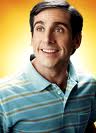
I also just finished reading “First Banana: Steve Carell and the meticulous art of spontaneity,” Tad Friend’s terrific profile of comedian Steve Carell that appears in the July 5, 2010, issue of The New Yorker.
Structure, of course, is a vital part of the seeming spontaneity of comedy. Discussing how there has been an increase in improvisation and collaboration (“Nowadays in the comedy industry, a Bucket Brigade of actors, writers, and directors pitches in to punch up one another’s films…”)in the creation of comedic movies in the last decade, Friend also is careful to emphasize the role carefully crafted structure plays in creating comedic effect; he states,
“It’s all a painstaking set of procedures aimed at maximum creativity, a huge planning effort to encourage accidents…But, even as members of the Bucket Brigade troll for every last chuckle, they remain mindful that it’s not the comedy in comedies that keeps people interested; it’s the structure. ‘Revenge of the Nerds’ and ‘My Big Fat Greek Wedding’ were nearly devoid of laughs, but they were big hits simply because of their clockwork plots. The screenwriter Dennis Klein observed, ‘In standup, improv is that ability to be funny at will, but in movies even Jim Carrey bending over and talking out of his ass will get cut if the improv doesn’t connect to the ongoing story.’ Dr. Evil’s ‘Sh!’ run works so well because his refusal to listen to Scott is what will allow Austin Powers to escape–and because he and Scott hate each other.”
Humor–and, more generally, good writing–needs surprise, and surprise needs structure. This is true of any kind of writing or communication, including comedy and poetry, that wants to be fresh and pack the wallop of the new.

I’ve recently become aware of and intrigued by some new thinking and work on the turn: Peter Sacks’s “You Only Guide Me by Surprise”: Poetry and the Dolphin’s Turn.
This work was first delivered on May 7, 2004, at The University of California, Berkeley, as the Second Memorial Judith Lee Stronach Lecture on the Teaching of Poetry. (You can hear the lecture here.) 500 copies of the lecture, printed by Autumn Press, have been published by The Bancroft Library of The University of California, Berkeley. For those interested in poetic turns, this slim volume is worth getting a hold of—it contains some fascinating reflections on a new kind (or, rather, an ancient kind—just one that so far has not been theorized) of turn: the dolphin’s turn.
According to Sacks, the dolphin’s turn is “a transformative veering from one course to another, a way of being drawn off track to an unexpected destination…” (Sacks adds: “[T]his turn is paradigmatic for the transportation system of poetry itself, both in its technical “versing,” and in its thematic and figural changes.”) The dolphin is associated with such turning, of course, because it is a creature that itself is always transgressing boundaries, leaping and diving. Sacks states,
“Imagine that we are sailing, or swimming, or watching, or drowning—which we are. Suddenly (a natural adverb of the dolphin, since sudden derives from underneath, from the same sub as sub-marine, going below or above, sur-facing, by sur-prise, as from hidden depths), a creature emerges. It breaks the surface between two elements, perhaps as the poem breaks from silence to sound and back, line after line, leaping and turning through what differentiates poetry from prose: its more frequent encounters with wordlessness, its high quota of turns, both of speech and thought, and of actual lineation, its navigating according to its own frequency even as it finds its course, responsively, by echolocation, by soundings.”
The dolphin’s turn, however, is more specific than this. According to Sacks, the dolphin’s turn is signaled by the actual presence of dolphins in a poem. That is, the dolphin becomes a kind of totemic animal, a familiar whose presence marks the presence of other, larger forces: the sighting of a dolphin in a poem often announces the advent of a radical turn. As Sacks states,
“[A]s the dolphin appears, imagine it has leapt not merely into your sight, but into your blood, breath, and the primal reaches of the mammalian mind, the part of us ‘in here’ that responds and perhaps corresponds to the creature ‘out there’….[T]his partial correspondence has charged the human imagination since the earliest poems of history. As we send exploratory pulses out toward the origins of poetry itself, the soundings ripple back to us through the waters of almost three millennia, from the “Homeric Hymn to Apollo” to such twentieth century poets as Eliot, Rilke, Mandelstam and Celan, as well as Lowell, Walcott, and Bishop, whose great vocational portrait, “The Riverman,” begins “I got up in the night / for the dolphin spoke to me.” Always en route, the dolphin makes its way, and poetry’s way, via Shakespeare, Milton, and many others. You may already be recalling that the crucial turning point of “Lycidas” (1637), “Weep no more, woeful shepherds, weep no more, / For Lycidas your sorrow is not dead,” leaps from the preceding lines, “Look homeward angel now, and melt with ruth: / And, O ye dolphins, waft the hapless youth.”

Etymologically connecting dolphin via its Greek designation, delphin, to the oracular Apollo of Delphi, Sacks notes, in fact, that “[t]he link between dolphin and lyric poetry could hardly be closer.” And Sacks’s lecture, then, becomes, largely, a consideration of many of the instances of the dolphin’s turn in poetry, investigating poems such as:
“Homeric Hymn to Pythian Apollo” (“Celebrating the inauguration of the Delphic oracle, and most importantly, Apollo’s selection of his first priests, a scene of election that literally turns them from one life-course to another, the poem enacts the ur trope of poesis itself. This marks one of the first, but by no means the last, scenes of hijacking in all of literature, and we may wonder to what degree the experience of a lyric poem resembles the action of being hijacked”);
Rainer Maria Rilke’s “Delphine” (“The poem speaks completely for itself, returning explicitly to a wondrous silence which it has served to deepen, even as it has mediated between otherwise separate categories of human, animal, divine, of ocean, earth, and heaven, of language, music, wordlessness”);
Osip Mandelstam’s “There is no need for speech” (“It’s a brief poem, two quatrains, in which the Russian word delphinom becomes the literal vehicle for the metaphoric tenor of the soul, a being that swims way beyond or beneath language or pedagogy, into the furthest reaches of consciousness or of the world as we perceive it”);
Paul Celan’s “What’s written goes hollow, what’s” (from Celan’s Atemwende, or Breathturn; “[t]he dolphin here draws the poet through the surfaces of language, into a primordial form of breath and drastic luminosity, inseparable from an eternalized, as well as internalized, quadrant of shadows”);
W.B. Yeats’s “News for the Delphic Oracle” (in which “a dolphin plunges through the whole middle stanza”);
early versions of Yeats’s “Sailing to Byzantium” (“When the stricken, aging speaker calls to the transfigured world of the mosaics, and prays that the sages who stand in God’s holy fire might gather him into the artifice of eternity, we might want to know that earlier drafts of this passage had included the lines “O send the dolphins back & gather me / Into the artifice of eternity.” Drafts of earlier passages of the poem show more instances of the legendary creature, seen through the foam “where the dark drowsy fins a moment rise / Of fish, that carry souls to paradise”);
Herman Melville’s Moby Dick (a dolphin appears at “the moment when Melville’s prose literally turns to poetry…to pray for a specifically Delphic salvation from the threatening whale”);
Robert Lowell’s “Dolphin” (from his penultimate collection, The Dolphin; “[h]ere the dolphin, figure also for the new beloved, cuts through the speaker’s self-imprisoning net of cerebration and will, releasing him and orienting him at once toward his ongoing vitality, and thence to his capacity for acknowledging the consequences of his past”);
and Elizabeth Bishop’s “The Riverman” (“a conversionary calling of a man by a dolphin, leading him to initiation as a shamanic servant of the natural and supernatural worlds”; “It strikes me as no coincidence that Bishop’s fullest exploration of shamanic election, of initiation into a salvific region involving its own language, i[t]s own elusive journeys and trysts, its devotion to the well-being of a community, should follow the calling of the dolphin. Not a poet usually given to myth-making, Bishop here delegates a receiver by whom she can express the strongest, most mysterious reach of her own vocation. In a sense, the dolphin has surprised her and admitted her into one of her own deepest acknowledgments of the summons to poetry and to the world”).
In a final note, Sacks also acknowledges other examples of the dolphin’s turn in poetry, including Robert Browning’s “Fifine at the Fair,” Theodore Roethke’s “A Dolphin at My Door,” C. Day-Lewis’s “Boy with Dolphin: Verocchio,” and (“the magnificent close of”) Derek Walcott’s book-length poem, The Prodigal.
Original, resonant, wide-ranging, deep, and new, Peter Sacks’s thinking about the dolphin’s turn is worth careful consideration. I highly recommend it.

Researching for a project I’m working on regarding the ways we value poems (or, more specifically, the ways we avoid talking seriously about what we value in poetry), I looked again at Matthew Zapruder’s “Show Your Work!”
Looking at the comments following Zapruder’s essay, I came across some of my own comments, many of which discuss the turn. As they’re relevant to what is covered on this blog, and as, in them, I make some significant claims about the power of paying attention to turns, I’ve decided to re-publish a few of them below. I think these comments have some good ideas in them that can be understood on their own, but I offer a few other comments in order to provide context. For full context, of course, just click on the above link and read away!
My discussion of the turn was prompted by the following comment:
A thoughtful essay. But what’s missing, I think, is a discussion regarding the influence that K-12 education has on criticism, poetry appreciation, and the writing of poems. Contemporary poetry may be discussed, with some limits, in the college or mfa program, but rarely is it touched thoughtfully in k-12 education. The problem with poetry appreciation and a newer, creative reading of newer works may be that the template for a poem, as was learned by so many of us in our k-12 experience, denies that kind of thing. Many k-12 educators go as far and Langston Hughes, and that’s all.
So anyhow, I lost my train of thought. Here’s my final comment: we need critics who are familiar with not just poetry, but design, music , art and current events so as to coin a new critical language. The new critic should have a strong background in multiple disciplines to be of any use. Then, once their criticism is deemed valuable, the crticism must be published, and not just in jounals, but elsewhere for those who have had a template- experience of the rhymed art.
There’s a problem in marketing that should also be discussed.
Random J
To this I responded:
J,
If I may be so bold (having been emboldened by your recognition of the need for greater marketing for certain kinds of poetry):
I’ve been doing some work to try to create (or, rather, to make clear), to use your phrase, one new “template” for encountering and writing poems, one which provides a way to engage a variety poems, from the canonical and traditional to the avant-garde. My “template” has much less interest in poetry as “rhymed art” but instead considers poems in terms of their structure, the types of turns they take. I think a focus on the poetic turn is one way to potentially spark more interest in poetry, and to show the connections between (seemingly) more accessible poetry and (seemingly) more difficult poetry.
If you’re interested, you can read more on this at my blog…
Best,
Mike
Prompted by a request for more information, I added the followng:
I’m happy to say a few more words about my work with turns.
***
Matthew notes in his essay that “…poets and poetry critics have not done the hard work necessary to explore, refine, and develop whatever terms might help us to even begin to talk about poetry in ways useful to understanding it,” and this, in large part, is a result and a continuation of a situation in which so many of the terms we currently use (such as, as Matthew suggests, “narrative” and “lyric”) “don’t exclude or refine any behavior at all in poetry.” I think that the turn offers a new term (or reintroduces a term) to the conversation about poetry, one which has real potential to shake things up, to change behaviors, both in terms of criticism and pedagogy. I will very briefly sketch out that potential here.
***
In criticism, attention to the turn reveals connections between seemingly disparate kinds of poems and aesthetics. The turn certainly is a feature of “accessible” poetry. A very large percentage of the poems in Billy Collins’s Poetry 180 feature the turn. However, the turn also is a key to the poetics of many “difficult” poets. In “Something of Moment,” her introduction to the issue of Ploughshares she edited (in Winter 2001-02), Jorie Graham argues that “[i]n a poem, one is always given…a stage upon which the urgent act of mind of this particular lyric occasion… ‘takes place,’” thus offering the poem an opportunity to “break.” According to Graham, “All such moments—where we are taken by surprise and asked to react—are marked places in consciousness, places where a ‘turn’ is required.” In fact, Hank Lazer, in “Lyricism of the Swerve: The Poetry of Rae Armantrout” (in American Women Poets in the 21st Century, and in Lyric and Spirit), argues that the turn is a central feature of Armantrout’s poetry.
***
Paying attention to the fact that a lot of poems turn, then, is one way, if one wants, to break down distinctions between established groups of poems. However, paying attention to exquisite, thrilling, truly witty, or sublime turns also offers a way to create new distinctions. There have been (in other discussions, including Reginald Shepherd’s “One State of the Art”) numerous calls for more attention to the poem and not to poets or movements, etc. The turn provides one way to turn the attention to individual, singular poems. And recognizing poems with particularly intriguing turns offers one way to divide oeuvres and schools: some of the poems in any oeuvre or school have turns that are flat and unsurprising, and some have turns that are random, and some have turns that amaze.
***
Such thinking has many applications. (In fact, my current project is writing a book which spells out these applications.) Here, I’ll simply note that attention to the turn has been influential in my own criticism (much of it published in Pleiades). It has offered me a way to combine the jobs of the critic, to argue, at times, that “something is good, or bad,” but it also has allowed me (to some extent) “to write, with focus and clarity, about how the piece of art works, what choices the artist has made, and how that might affect a reader,” but without relying too much on my own personality. (One quick example: in a review of recent haiku, I considered haiku not as a formal unit (5-7-5) but as a structural unit incorporating a turn. Not many of the haiku I reviewed were, in that new light, at all good—no surprises there—but I do think that I also made the value of those few haiku that did have structural intrigue clear. Attention to turns also allowed me to disregard many previous distinctions between haiku—poet, school, etc—and to value individual haiku across the spectrum of poets and schools.)
***
The really substantive application for the turn, however, is in pedagogy, which might be considered enacted criticism. In pedagogy, the turn offers much. The turn is, or easily can be made to seem, familiar to students—everyday language includes all kinds of argumentative, dramatic, and emotional turns; with a little training, students (high school…perhaps junior high?) can see this. Reminded that they themselves in fact are sophisticated language users, students then can recognize and appreciate turns in poems, and perhaps be more ready, able, and willing to apply such recognition and appreciation to not only accessible poetry but also more seemingly difficult poetry. How much better off (college/graduate) poetry classrooms would be if, rather than entering those classes thinking that poems “flow” students instead knew that (lots of) poems “turn”…
***
I’ve gone on way too long. For more info, check out the turn blog…
***
Cheers,
Mike
I’ve added a new page to the Pedagogy section of this blog, Poetic Structures, Summarized.
This page is designed to serve as a convenient handout for educators, and a helpful cribsheet for students.
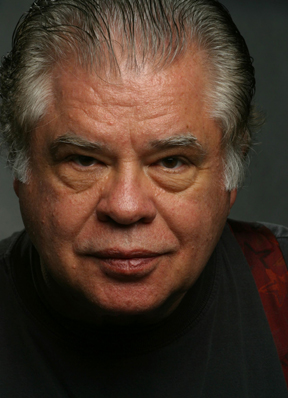
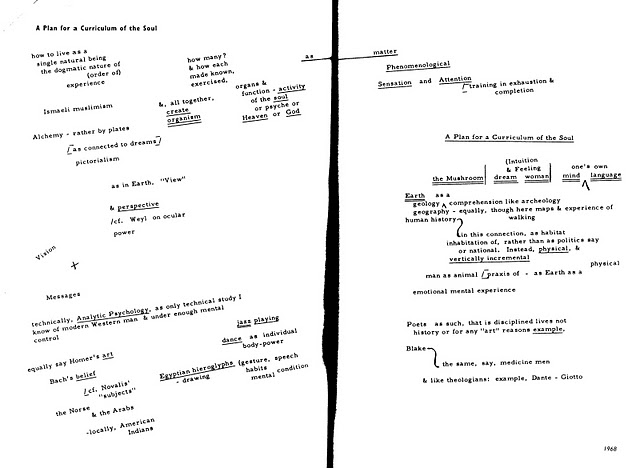
As a part of some work with a colleague to rethink a particular poetry writing course, I spent a terrific two hours this afternoon sailing through Clayton Eshleman‘s Novices: A Study of Poetic Apprenticeship. A strange and magical book, I think.
As its subtitle indicates, Novices primarily is an excellent collection of reflections on the fuller demands of poetic apprenticeship. One of the aspects of the book that I like very much is that it presents some “plans,” “outlines,” and “curricula” for a training in poetry that other poets have suggested, including those by Charles Olson, Gary Snyder, and (though Eshleman is critical of his “daydream College for Bards”) W.H. Auden. Perhaps my favorite chapter in the book is Chapter 9, in which Eshleman uses Snyder’s “What You Should Know to Be a Poet” as a springboard to launch himself into a discussion of his own theory of apprenticeship, which consists of four “nodes”: “EXPERIENCE,” “RESEARCH,” “SELF-REGULATION,” and “EXPERIMENT.” Worth looking into.
(Those intrigued by the prospect of thinking more deeply about a fuller poetic apprenticeship might also read H.L. Hix’s “Training for Poets” in As Easy as Lying: Essays on Poetry.)
Of course, though, what also caught my eye (trained on the turn) was a passage from Novices‘ Chapter 7 in which Eshleman emphasizes the role of the turn (or turns) in poems. He states:
“There is an archetypal poem, and its most ancient design is probably the labyrinth. One suddenly cuts in, leaving the green world for the apparent stasis and darkness of the cave. The first words of a poem propose and nose forward toward a confrontation with what the writer is only partially aware of, or may not be prepared to address until it emerges, flushed forth by digressions and meanders. Poetry twists toward the unknown and seeks to realize something beyond the poet’s initial awareness. What it seeks to know might be described as the unlimited interiority of its initial impetus.”
Whether a labyrinth or something else, it certainly is true that poetry twists and turns. While in the process of learning much and cultivating a variety of necessary dispositions and skills, any apprentice to the art of poetry must attend to this aspect of poetry, considering and practicing the art of the turn.
Hi, All,
Turns out, I took some time off from blogging during the academic year…
Well, it’s summertime, so let the new posts begin!
If you’re a new visitor, welcome– If you’ve visited this blog before, thanks for sticking around–
Cheers!
Mike
 Structure & Surprise