The Monkey & the Wrench

15 01 2011

Hot off the press: The Monkey & the Wrench: Essay into Contemporary Poetics, edited by Mary Biddinger and John Gallaher.  As its back cover material correctly states,

The Monkey & the Wrench: Essays into Contemporary Poetics takes a snapshot of a moving target: the ever-shifting conversation about today’s poetry.  The ten essays in this collection offer reflections and insights, practical advice for craft matters, and provocative points of departure for those who read and write poetry.”

The ten essays include work by some terrific poets and critics, including Bob Archambeau, Elisa Gabbert, Michael Dumanis, Stephen Burt, Benjamin Paloff, Elizabeth Robinson, David Kirby, Cole Swensen, and Joy Katz.  (For a good sense of what’s in the book, go to editor John Gallaher’s blog post on the book, here.)

I was fortunate to have a short essay published in this book, as well.  Last year, with Mark Wallace, I co-organized a panel, called “Hybrid Aesthetics and Its Discontents,” for the annual Association of Writers and Writing Programs conference.  Editor John Gallaher attended the panel, and, afterwards, asked if we might like to publish the papers delivered in the panel in The Monkey & the Wrench.  We took John up on his offer.

The papers included in “Hybrid Aesthetics and Its Discontents” are Mark Wallace’s “Against Unity,” my own “No Laughing Matter: The Humorless Hybrid,” Arielle Greenberg’s “Hybridity in Gurlesque Poetry,” Craig Santos Perez’s “Whitewashing American Hybrid Aesthetics,” and Megan Volpert’s “A Drag Queen’s Lament: Or, how I learned to stop worrying and love my camp.”  Each of these papers, in its own way and to its own degree, critiques the growing phenomenon of hybridity in American poetry, especially as it appears in American Hybrid: A Norton Anthology of New Poetry.  In the words of the introduction to our panel papers:

“In ‘Against Unity,’ Mark Wallace challenges the application of what he sees as the overly simple two-camp model to a much more complex contemporary American poetry scene, and, while he continues to call for hybridity in poetry, the hybridity he hopes for is a stranger, even more monstrous kind of hybridity than is found in American Hybrid.  In ‘No Laughing Matter: The Humorless Hybrid,’ Michael Theune reveals that hybridity, while meant to synthesize, in fact reinscribes a significant division in American poetry: that between the serious and the comedic.  In ‘Hybridity in Gurlesque Poetry,’ Arielle Greenberg considers another kind of hybridity, the Gurlesque, a more extreme and vigorous hybrid than is typically encountered in hybrid anthologies.  Both Craig Santos Perez and Megan Volpert reveal the culturally conservative trends in hybrid anthologizing; in ‘Whitewashing American Hybrid Aesthetics,’ Perez critiques American Hybrid for not representing America’s racial and ethnic diversity, and in ‘A Drag Queen’s Lament: Or, how I learned to stop worrying and love my camp,’ Volpert critiques the relatively conservative sexual politics of hybridity and calls for a poetry of unapologetic, queer difference.” (119)

I hope any and all who are curious about, and perhaps a bit skeptical of, hybrid poetry check out “Hybrid Aesthetics and Its Discontents.”

For those interested in matters of the poetic turn, I’ll simply say that my short essay makes a point that I’ve tried to make in different ways in different venues (including here, and here): that hybrid poetry typically does not (and perhaps cannot) deliver truly amazing, witty, fitting and surprising turns.  From my essay:

“Humor requires great orchestration, the management of great, playful leaps.  What the hybrid, with its recombinations, its disruptions and scramblings (which very often come to seem like, and which hybrid thinking so far has done nothing to differentiate from, mere short circuiting), has real trouble creating is wit.  Wit—recognized as one of the rarest of all poetic achievements; in his essay ‘Andrew Marvell,’ T.S. Eliot calls wit ‘something precious and needed…’ (263)—is such a precious achievement because in order to create it one must create a sense of fitting surprise, a state in which language both delivers on expectations yet leaps beyond them.  As Barbara Herrnstein Smith notes in Poetic Closure: A Study of How Poems End, ‘A hyperdetermined conclusion will have maximal stability and finality; and when these qualities occur in conjunction with unexpected or in some way unstable material…the result will be wit—which, as many have observed, occurs when expectations are simultaneously surprised and fulfilled’ (206).  Wit requires a real synthesis, and humor requires the skillful, effective combination of attentiveness to the brain and the guts and the groin.  The hybrid offers no vision of what a successful recombination of poetic elements is; though it talks of synthesis, its poems don’t have to have wit’s synthesis, and rather are allowed to be messy amalgamations.  Perhaps exquisite, singular poetic syntheses are omitted from hybrid anthologies because they would put to the test the value of hybridity in general.” (131-32).

Joy Katz’s essay, “Goodbye, Goodbye, Goodbye: Notes on the Ends of Poems,” also contains some interesting insights for those intrigued by turns in poetry.  I hope to discuss her essay in another post in the very near future.


Close Reading “Close Reading: Windows”

9 01 2011

As I have stated elsewhere on this blog (such as here, and by including many of her poems as exemplars of particular types of turns), poet-critic Jane Hirshfield is one of today’s great advocates and practitioners of the poetic turn.  Hirshfield’s advocacy for the turn continues in her latest, excellent essay on poetry, “Close Reading: Windows” (The Writer’s Chronicle 43.4 (Feb. 2011): 22-30).

Hirshfield begins her essay, stating, “Many good poems have a kind of window-moment in them–a point at which they change their direction of gaze or thought in a way that suddenly opens a broadened landscape of meaning and feeling.  Encountering such a moment, the reader breathes in some new infusion, as steeply perceptible as any physical window’s increase of light, scent, sound, or air.  The gesture is one of lifting, unlatching, releasing; mind and attention swing open to newly peeled vistas.”

Though Hirshfield notes that such window-moments may be momentary elements within a poem, most often the window-moment is associated with the turn.  Hirschfield states, “In the swerve into some new possibility of mind, a poem with a window stops to look elsewhere, drawing on something outside of its self-constructed domain and walls.  A window can be held by a change of sense realms or a switch of rhetorical strategy, can be framed by a turn of grammar or ethical stance, can be sawn open by an overt statement or slipped in almost unseen.  Whether large or small, what I am calling a window is recognized primarily by the experience of expansion it brings: the poem’s nature is changed because its scope has become larger.”

The relation between the window-moment and the turn is made even clearer when one considers that many of the poems Hirshfield discusses in her essay have major turns, turns which often are equated with the window-moment. 

The turn in the final stanza of Philip Larkin’s “High Windows” is the major window-moment in the poem, the place where, according to Hirshfield, the poem “suddenly turns.”  (In Structure & Surprise, Christopher Bakken considers “High Windows” a poem employing an ironic structure.)  

A vital window-moment in Emily Dickinson’s “We grow accustomed to the Dark–“ (a poem that employs a Metaphor-to-Meaning Structure) occurs at the poem’s major turn from metaphor to meaning; as Hirshfield notes, “‘And so of larger–Darkness– / Those Evenings of the Brain– / When not a Moon disclose a sign– / Or Star–come out–within–‘  With these lines, the poem moves into charged terrain.”

In Wislawa Szymborska’s Some People, a poem employing a List-with-a-Twist Structure, the window-moment occurs at the poem’s final twist.  As Hirshfield notes of the poem’s third-to-last line, “With that line’s grammatical knife-twist, certain kinds of awareness we were not even aware had been supressed rush back into the poem.”

The major turn in Czeslaw Milosz’s “Winter,” again, turns out to be its window-moment.  Hirshfield, in fact, calls the poem’s “mid-point turn to the vocative ‘you'” one of “the most breathtaking transitions and window-openings to be found anywhere in poetry, in its intimacy and in what it summons.”

I learned a great deal from “Close Reading: Windows.”  Not the least of this learning came from being introduced to (or reminded of) of some excellent poems with amazing turns in them.  I added Dickinson’s poem to the Metaphor-to-Meaning Structure page and I added Szymborska’s poem to the List-with-a-Twist Structure page after reading Hirshfield’s excellent, informative essay.  Inspired by and agreeing with Hirshfield, I also decided to add Milosz’s poems to the list of poems on Voltage!, the page of this blog devoted to poems that have truly shocking and amazing, truly electric, turns.

I’ve been deeply impressed by some vital new writing on issues intimately related to the turn, writing such as Peter Sack’s “‘You Only Guide Me by Surprise’: Poetry and the Dolphin’s Turn” and Hank Lazer’s “Lyricism of the Swerve: The Poetry of Rae Armantrout” (collected in Lyric & Spirit: Selected Essays 1996-2008).  Jane Hirshfield’s “Close Reading: Windows” certainly takes its place among these important works, doing its part to help reveal the relevance and the significance of the turn in poetry today.


Considering “A Display of Mackerel”

9 01 2011

I’ve just updated this blog’s Emblem Structure page in order to include a link to “Souls on Ice,” a reflection by Mark Doty on the process of composing his gorgeous emblem poem “A Display of Mackerel.”  (The reflection and the poem may be found here.)

Of special interest for those interested in poetic turns is the clear delight–and even amazement–Doty feels when he discovers the moments of the poem that become the poem’s major turns.  For example, of an important focusing of the initial description of the mackerel, Doty writes, “There’s a terrific kind of exhilaration for me at this point in the unfolding of a poem, when a line of questioning has been launched, and the work has moved from evocation to meditation.” 

And of the point when the poem’s act of thoughtful (even meditative) description turns to more focused meditation, Doty writes, “The poem had already moved into the realm of theology, but the question that arose (“Suppose we could iridesce . . .”) startled me nonetheless, because the notion of losing oneself “entirely in the universe/ of shimmer” referred both to these fish and to something quite other, something overwhelmingly close to home….”

Mark Doty’s “Souls on Ice” is a terrific phenomenological account of poem-making, one that acknowledges the difficulties and false starts and dead ends of writing, but also celebrates the sense (and reality?) of poetic accomplishment–and particularly the thrilling accomplishment of discovering and then engaging poetic turns.


Don’t Just “Use the Force” or “Go with the Flow”–You Gotta “Trust the Turn”!

27 07 2010

My essay “Trust the Turn: Focusing the Revision Process in Poetry” has just been published in Poets on Teaching: A Sourcebook, edited by Joshua Marie Wilkinson (U of Iowa P, 2010).

A version of the essay can be found here, but you should get the book–it’s terrific!  (The good John Gallaher agrees, here.)  Tons (99, to be exact) of great (micro-)essays on teaching poetry by some excellent poets and poet-teachers, including a number of those associated with Structure & Surprise, such as Timothy Liu, Peter Gizzi, Rachel Zucker, Prageeta Sharma, D. A. Powell, and Mark Yakich.  (Not to mention a whole bunch of friends, mentors, colleagues, sparring partners, and role models, including Srikanth Reddy, Laura Mullen, Mark Wallace, Catherine Wagner, Brenda Hillman, John Gallaher himself, Johannes Goransson, Arielle Greenberg, Kent Johnson, Matthew Zapruder, Lara Glenum, Sabrina Orah Mark…the list goes on!)

Do note that–if you do get the book and you are interested in turns–there is at least one other essay that reveals interest in turns: Karla Kelsey’s “Teaching Writing through the Sonnet Tradition.”  Kelsey includes the following among her “favorite prompts”:

“Reconsidering the turn: turn as rhetorical moment, as change in speaker, as change in perceptual attention, as change in visual register…”

Hopefully, Structure & Surprise serves as a good starting point for those who want to (re-)consider the turn!


Amen

16 07 2010

The sonnet’s volta, or “turn”…has become an inherent expectation for most short lyric poems.

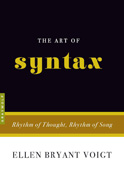
–Ellen Bryant Voigt, The Art of Syntax: Rhythm of Thought, Rhythm of Song


Haiku and Fitting Surprise

8 07 2010

In a recent post, I cite a terrific paragraph from Arthur Plotnik’s Spunk & Bite.  That paragraph, titled “Surprisingly Apt,” reads:

“Ultimately, the devices of surprise may set up the pins, but they don’t guarantee the strike.  The essence of surprise is in its timing and execution: fast, graceful, and apt.  Aptness is paramount.  The best surprise of all may be how precisely an unexpected word or image pops a message.  Unexpected is easy; unexpectedly perfect helps separate writers from hacks.”

As I note in that post, what I like so much about this paragraph is that it jibes with a quality of writing that I’m very taken by: a quality I call “fitting surprise,” that moment in writing when something occurs that is both unexpected and yet truly apt.  “Fitting surprise” is not a kind of turn, but rather a quality of turn I value highly.

For those (potentially) interested in this quality of turn, I thought I’d highlight an essay I wrote a few years back that offers my clearest statement about what I think fitting surprise is: “Writing Degree ∞ (on Recent Haiku).”

While generally a review of some recent haiku, “Writing Degree ∞” also offers some history of the concept of fitting surprise (for example, how it is discussed by artists, writers, and critics such as Lee Gurga, Rene Magritte, Pierre Reverdy, Barbara Herrnstein Smith, Margaret Atwood, Antonya Nelson, and Randall Jarrell) and employs the concept critically, showing how the application of the concept actually can make a difference in how one thinks about, in this instance, haiku.  (I suggest that the more structural quality of fitting surprise should trump formal considerations when trying to determine what are successful (or: awesome, astounding, wonderful…) haiku–haiku form (three lines of 5, 7, and 5 syllables, respectively) offers very little in terms of how to judge the success of a haiku (anyone can write a 5-7-5 haiku!) whereas the mysterious, difficult, and amazing quality of fitting surprise offers a worthy criterion: if one detects the presence of fitting surprise in a haiku, that haiku is doing something powerful, something singular.)

Please note that while I hope all of “Writing Degree ∞” is worth paying attention to, the essay’s turn to discussing fitting surprise and its role in the evaluation of haiku begins with the final paragraph on p. 150.


Peter Sacks and the Dolphin’s Turn

1 07 2010

I’ve recently become aware of and intrigued by some new thinking and work on the turn: Peter Sacks’s “You Only Guide Me by Surprise”: Poetry and the Dolphin’s Turn.

This work was first delivered on May 7, 2004, at The University of California, Berkeley, as the Second Memorial Judith Lee Stronach Lecture on the Teaching of Poetry.  (You can hear the lecture here.)  500 copies of the lecture, printed by Autumn Press, have been published by The Bancroft Library of The University of California, Berkeley.  For those interested in poetic turns, this slim volume is worth getting a hold of—it contains some fascinating reflections on a new kind (or, rather, an ancient kind—just one that so far has not been theorized) of turn: the dolphin’s turn.

According to Sacks, the dolphin’s turn is “a transformative veering from one course to another, a way of being drawn off track to an unexpected destination…”  (Sacks adds: “[T]his turn is paradigmatic for the transportation system of poetry itself, both in its technical “versing,” and in its thematic and figural changes.”)  The dolphin is associated with such turning, of course, because it is a creature that itself is always transgressing boundaries, leaping and diving.  Sacks states,

“Imagine that we are sailing, or swimming, or watching, or drowning—which we are.  Suddenly (a natural adverb of the dolphin, since sudden derives from underneath, from the same sub as sub-marine, going below or above, sur-facing, by sur-prise, as from hidden depths), a creature emerges.  It breaks the surface between two elements, perhaps as the poem breaks from silence to sound and back, line after line, leaping and turning through what differentiates poetry from prose: its more frequent encounters with wordlessness, its high quota of turns, both of speech and thought, and of actual lineation, its navigating according to its own frequency even as it finds its course, responsively, by echolocation, by soundings.”

The dolphin’s turn, however, is more specific than this.  According to Sacks, the dolphin’s turn is signaled by the actual presence of dolphins in a poem.  That is, the dolphin becomes a kind of totemic animal, a familiar whose presence marks the presence of other, larger forces: the sighting of a dolphin in a poem often announces the advent of a radical turn.  As Sacks states,

“[A]s the dolphin appears, imagine it has leapt not merely into your sight, but into your blood, breath, and the primal reaches of the mammalian mind, the part of us ‘in here’ that responds and perhaps corresponds to the creature ‘out there’….[T]his partial correspondence has charged the human imagination since the earliest poems of history.  As we send exploratory pulses out toward the origins of poetry itself, the soundings ripple back to us through the waters of almost three millennia, from the “Homeric Hymn to Apollo” to such twentieth century poets as Eliot, Rilke, Mandelstam and Celan, as well as Lowell, Walcott, and Bishop, whose great vocational portrait, “The Riverman,” begins “I got up in the night / for the dolphin spoke to me.”  Always en route, the dolphin makes its way, and poetry’s way, via Shakespeare, Milton, and many others.  You may already be recalling that the crucial turning point of “Lycidas” (1637), “Weep no more, woeful shepherds, weep no more, / For Lycidas your sorrow is not dead,” leaps from the preceding lines, “Look homeward angel now, and melt with ruth: / And, O ye dolphins, waft the hapless youth.”

Etymologically connecting dolphin via its Greek designation, delphin, to the oracular Apollo of Delphi, Sacks notes, in fact, that “[t]he link between dolphin and lyric poetry could hardly be closer.”  And Sacks’s lecture, then, becomes, largely, a consideration of many of the instances of the dolphin’s turn in poetry, investigating poems such as:

“Homeric Hymn to Pythian Apollo” (“Celebrating the inauguration of the Delphic oracle, and most importantly, Apollo’s selection of his first priests, a scene of election that literally turns them from one life-course to another, the poem enacts the ur trope of poesis itself.  This marks one of the first, but by no means the last, scenes of hijacking in all of literature, and we may wonder to what degree the experience of a lyric poem resembles the action of being hijacked”);

Rainer Maria Rilke’s “Delphine” (“The poem speaks completely for itself, returning explicitly to a wondrous silence which it has served to deepen, even as it has mediated between otherwise separate categories of human, animal, divine, of ocean, earth, and heaven, of language, music, wordlessness”);

Osip Mandelstam’s “There is no need for speech” (“It’s a brief poem, two quatrains, in which the Russian word delphinom becomes the literal vehicle for the metaphoric tenor of the soul, a being that swims way beyond or beneath language or pedagogy, into the furthest reaches of consciousness or of the world as we perceive it”);

Paul Celan’s “What’s written goes hollow, what’s” (from Celan’s Atemwende, or Breathturn; “[t]he dolphin here draws the poet through the surfaces of language, into a primordial form of breath and drastic luminosity, inseparable from an eternalized, as well as internalized, quadrant of shadows”);

W.B. Yeats’s “News for the Delphic Oracle” (in which “a dolphin plunges through the whole middle stanza”);

early versions of Yeats’s “Sailing to Byzantium” (“When the stricken, aging speaker calls to the transfigured world of the mosaics, and prays that the sages who stand in God’s holy fire might gather him into the artifice of eternity, we might want to know that earlier drafts of this passage had included the lines “O send the dolphins back & gather me / Into the artifice of eternity.”  Drafts of earlier passages of the poem show more instances of the legendary creature, seen through the foam “where the dark drowsy fins a moment rise / Of fish, that carry souls to paradise”);

Herman Melville’s Moby Dick (a dolphin appears at “the moment when Melville’s prose literally turns to poetry…to pray for a specifically Delphic salvation from the threatening whale”);

Robert Lowell’s “Dolphin” (from his penultimate collection, The Dolphin; “[h]ere the dolphin, figure also for the new beloved, cuts through the speaker’s self-imprisoning net of cerebration and will, releasing him and orienting him at once toward his ongoing vitality, and thence to his capacity for acknowledging the consequences of his past”);

and Elizabeth Bishop’s “The Riverman” (“a conversionary calling of a man by a dolphin, leading him to initiation as a shamanic servant of the natural and supernatural worlds”; “It strikes me as no coincidence that Bishop’s fullest exploration of shamanic election, of initiation into a salvific region involving its own language, i[t]s own elusive journeys and trysts, its devotion to the well-being of a community, should follow the calling of the dolphin.  Not a poet usually given to myth-making, Bishop here delegates a receiver by whom she can express the strongest, most mysterious reach of her own vocation.  In a sense, the dolphin has surprised her and admitted her into one of her own deepest acknowledgments of the summons to poetry and to the world”).

In a final note, Sacks also acknowledges other examples of the dolphin’s turn in poetry, including Robert Browning’s “Fifine at the Fair,” Theodore Roethke’s “A Dolphin at My Door,” C. Day-Lewis’s “Boy with Dolphin: Verocchio,” and (“the magnificent close of”) Derek Walcott’s book-length poem, The Prodigal.

 Original, resonant, wide-ranging, deep, and new, Peter Sacks’s thinking about the dolphin’s turn is worth careful consideration.  I highly recommend it.


Showing My Work

21 06 2010

Researching for a project I’m working on regarding the ways we value poems (or, more specifically, the ways we avoid talking seriously about what we value in poetry), I looked again at Matthew Zapruder’s “Show Your Work!”

Looking at the comments following Zapruder’s essay, I came across some of my own comments, many of which discuss the turn.  As they’re relevant to what is covered on this blog, and as, in them, I make some significant claims about the power of paying attention to turns, I’ve decided to re-publish a few of them below.  I think these comments have some good ideas in them that can be understood on their own, but I offer a few other comments in order to provide context.  For full context, of course, just click on the above link and read away!

My discussion of the turn was prompted by the following comment:

A thoughtful essay. But what’s missing, I think, is a discussion regarding the influence that K-12 education has on criticism, poetry appreciation, and the writing of poems. Contemporary poetry may be discussed, with some limits, in the college or mfa program, but rarely is it touched thoughtfully in k-12 education. The problem with poetry appreciation and a newer, creative reading of newer works may be that the template for a poem, as was learned by so many of us in our k-12 experience, denies that kind of thing. Many k-12 educators go as far and Langston Hughes, and that’s all.

So anyhow, I lost my train of thought. Here’s my final comment: we need critics who are familiar with not just poetry, but design, music , art and current events so as to coin a new critical language. The new critic should have a strong background in multiple disciplines to be of any use. Then, once their criticism is deemed valuable, the crticism must be published, and not just in jounals, but elsewhere for those who have had a template- experience of the rhymed art.

There’s a problem in marketing that should also be discussed.

Random J

To this I responded:

J,

If I may be so bold (having been emboldened by your recognition of the need for greater marketing for certain kinds of poetry):

I’ve been doing some work to try to create (or, rather, to make clear), to use your phrase, one new “template” for encountering and writing poems, one which provides a way to engage a variety poems, from the canonical and traditional to the avant-garde. My “template” has much less interest in poetry as “rhymed art” but instead considers poems in terms of their structure, the types of turns they take. I think a focus on the poetic turn is one way to potentially spark more interest in poetry, and to show the connections between (seemingly) more accessible poetry and (seemingly) more difficult poetry.

If you’re interested, you can read more on this at my blog…

Best,
Mike

Prompted by a request for more information, I added the followng:

I’m happy to say a few more words about my work with turns.

***

Matthew notes in his essay that “…poets and poetry critics have not done the hard work necessary to explore, refine, and develop whatever terms might help us to even begin to talk about poetry in ways useful to understanding it,” and this, in large part, is a result and a continuation of a situation in which so many of the terms we currently use (such as, as Matthew suggests, “narrative” and “lyric”) “don’t exclude or refine any behavior at all in poetry.” I think that the turn offers a new term (or reintroduces a term) to the conversation about poetry, one which has real potential to shake things up, to change behaviors, both in terms of criticism and pedagogy. I will very briefly sketch out that potential here.

***

In criticism, attention to the turn reveals connections between seemingly disparate kinds of poems and aesthetics. The turn certainly is a feature of “accessible” poetry. A very large percentage of the poems in Billy Collins’s Poetry 180 feature the turn. However, the turn also is a key to the poetics of many “difficult” poets. In “Something of Moment,” her introduction to the issue of Ploughshares she edited (in Winter 2001-02), Jorie Graham argues that “[i]n a poem, one is always given…a stage upon which the urgent act of mind of this particular lyric occasion… ‘takes place,’” thus offering the poem an opportunity to “break.” According to Graham, “All such moments—where we are taken by surprise and asked to react—are marked places in consciousness, places where a ‘turn’ is required.” In fact, Hank Lazer, in “Lyricism of the Swerve: The Poetry of Rae Armantrout” (in American Women Poets in the 21st Century, and in Lyric and Spirit), argues that the turn is a central feature of Armantrout’s poetry.

***

Paying attention to the fact that a lot of poems turn, then, is one way, if one wants, to break down distinctions between established groups of poems. However, paying attention to exquisite, thrilling, truly witty, or sublime turns also offers a way to create new distinctions. There have been (in other discussions, including Reginald Shepherd’s “One State of the Art”) numerous calls for more attention to the poem and not to poets or movements, etc. The turn provides one way to turn the attention to individual, singular poems. And recognizing poems with particularly intriguing turns offers one way to divide oeuvres and schools: some of the poems in any oeuvre or school have turns that are flat and unsurprising, and some have turns that are random, and some have turns that amaze.

***

Such thinking has many applications. (In fact, my current project is writing a book which spells out these applications.) Here, I’ll simply note that attention to the turn has been influential in my own criticism (much of it published in Pleiades). It has offered me a way to combine the jobs of the critic, to argue, at times, that “something is good, or bad,” but it also has allowed me (to some extent) “to write, with focus and clarity, about how the piece of art works, what choices the artist has made, and how that might affect a reader,” but without relying too much on my own personality. (One quick example: in a review of recent haiku, I considered haiku not as a formal unit (5-7-5) but as a structural unit incorporating a turn. Not many of the haiku I reviewed were, in that new light, at all good—no surprises there—but I do think that I also made the value of those few haiku that did have structural intrigue clear. Attention to turns also allowed me to disregard many previous distinctions between haiku—poet, school, etc—and to value individual haiku across the spectrum of poets and schools.)

***

The really substantive application for the turn, however, is in pedagogy, which might be considered enacted criticism. In pedagogy, the turn offers much. The turn is, or easily can be made to seem, familiar to students—everyday language includes all kinds of argumentative, dramatic, and emotional turns; with a little training, students (high school…perhaps junior high?) can see this. Reminded that they themselves in fact are sophisticated language users, students then can recognize and appreciate turns in poems, and perhaps be more ready, able, and willing to apply such recognition and appreciation to not only accessible poetry but also more seemingly difficult poetry. How much better off (college/graduate) poetry classrooms would be if, rather than entering those classes thinking that poems “flow” students instead knew that (lots of) poems “turn”…

***

I’ve gone on way too long. For more info, check out the turn blog…

***

Cheers,
Mike


Against “Narrative”

20 07 2009

Not equipped with other helpful paradigms for what it is that poetry does, many readers come to poetry thinking that it, like the other literature with which they’re acquainted, tells stories.  Such thinking, of course, is misleading—it’s not clear such thinking would help anyone really encounter and engage many poems.  Certainly, lots of poems make use of narrative elements, but lots of poems, even poems thought to be generally “accessible,” don’t.  Readers need to be presented with a different paradigm for how poems “work,” for what it is that poems “do.”

I think that the “turn” can be that paradigm.  As I discuss more fully in “The Structure-Form Distinction”: lots of poems turn; turns aren’t always primarily associated with narrative (they also are associated with argumentation, the recording of emotional shifts, etc); and turns are, or easily can be made to seem, familiar, as familiar as storytelling.

In fact, I think the paradigm of the turn is superior to the paradigm of narrative.  Turning is itself central to narrative.  One could be said to know very little about the nature of narrative if one did not know about the nature of narrative turns—from beginnings to conflicts to climaxes to resolutions.  And, again, turning is at work in poems that aren’t primarily narrative.

However, though turning is more vital to poetry than narrative, many conversations about poetry still use the language of narrative—“narrative,” “plot”—to discuss what really are (or could more accurately be described as) turns.  Such misnaming makes it seem that, no matter what is said about narrative and the turn, narrative takes prominence over the turn.  In order to keep at trying to give the turn its proper due, this situation needs to be recognized and addressed.

To be clear: my critique here is meant to be very specific and detailed—in fact, I greatly admire the substance of the three essays to be discussed in this essay—but, hopefully, not minor: I think it would be smart to do away with the discussion of non-narrative “plots” in poetry.  Mention of “plot” will always make readers think of narrative, and thus reinforce the seeming prominence of narrative.  We need to use different terms in order to shift the conversation—and, with “structure” and the “turn,” such different terms are available to us.  Instead of “narrative” and “plot,” I think we should use the term “structure,” and mean by “structure” something very specific: the pattern of a poem’s turning.  (For more on this, again, see “The Structure-Form Distinction.”)  In this way, we can discuss a poem’s rhetorical maneuvers without (potentially) confusing those maneuvers with narrative.

hoagland

In “Fear of Narrative and the Skittery Poem of Our Moment,” Tony Hoagland corroborates my sense that there’s a tendency to lump together a number of kinds of poetry (many of which are clearly related to poetic traditions that prominently involve turning) under “narrative”; he states, “Under the label of ‘narrative,’ all kinds of poetry currently get lumped together: not just story, but discursion, argument, even descriptive lyrics.  They might better be called the ‘Poetries of Continuity.’”  Interestingly, though Hoagland himself suggests a better name for narrative, he also reveals the power of the “narrative” in discussions of poetry: his essay’s title employs the phrase “Fear of Narrative,” not “Fear of Continuity.”

(A bit off topic, but, I must add: it’s too bad that Hoagland links the poetry he does only to continuity—lots of poems that are not at all “skittery” work by means of an organized discontinuity.  As Randall Jarrell says in “Levels and Opposites: Structure in Poetry”: “A successful poem starts in one position and ends at a very different one, often a contradictory or opposite one; yet there has been no break in the unity of the poem.”  And Hoagland himself seems to recognize this; later in his essay, he states, “Narrated and associative poems are not each other’s aesthetic opposites or sworn enemies.  Obviously these modes don’t necessarily exclude each other.  They overlap, coexist, and often cross-pollinate.”)
dennis

The focus on narrative in poetry is more directly and fully addressed in Carl Dennis’s “The Temporal Lyric.”  Dennis notes, “Although lyrics are more likely to be organized rhetorically, especially those that present arguments, are much more common than those that present psychological narratives, discussion of the lyric has suffered from the fact that the oldest and most influential piece of criticism of poetry in the West, Aristotle’s Poetics, is formulated with specific reference not to lyric poetry but to drama and to epic and so presents temporal plotting as the central element of the poem.”  Dennis then notes a different way to approach lyric poems, one that comes out of speech-act theory:

“Here the poem is regarded as a dramatic event in which a fictive speaker performs a speech act that gives specific embodiment, in a particular context, to one or more of the basic tasks that we ask ordinary language to perform—explaining, questioning, demanding, promising, apologizing, praising, castigating, pleading, and the like.  Each of these acts has its particular plot if we use the term to refer not to a sequence of temporal events but to a sequence of rhetorical moves that carry out the task that the specific function requires.  Such a completed action possesses the wholeness that Aristotle demands of a poem: it possesses a proper beginning, middle, and an end, the order of incidents being such that transposing or removing any one of them will disorder the whole.”

Dennis is trying to replace a narrative orientation to poetry with a rhetorical one, and that rhetorical orientation clearly has much to do with turning: I assume that the “rhetorical moves” that comprise the “plot” of the speech act either are turns, or else clearly imply turns (turns allow the transition from one “plot” point to another).  And, indeed, the poems Dennis investigates in his essay (Marvell’s “To His Coy Mistress,” Donne’s sonnet “At the round earth’s imagined corners, blow,” Dickinson’s “These are the days when Birds come back—,” Frederick Goddard Tuckerman’s sonnet “An upper chamber in a darkened house,” and Bishop’s “The Fish”) all feature very clear and distinct turns, and Dennis in fact refers to the turn at least twice in his examination of these poems.

Again, substantively, I greatly agree with Dennis; however, I think that the use of the word “plot” (which Dennis uses off and on throughout his essay), no matter how it is defined, tends to suggest narrative—precisely what Dennis does not want to suggest.  A more neutral and apt term, I think, for Dennis’s plot of rhetorical moves (and a term Dennis himself occasionally employs), is “structure.”

romantic

The same holds true, for the most part, in regard to Jack Stillinger’s “Reading Keats’s Plots.”

Stillinger’s essay does two things: 1) it argues that we need to spend more time examining the plots of poems in general, and of Keats’s poems, in particular, and 2) it examines the plots of some key poems by Keats (The Eve of St. Agnes, Lamia, “La Belle Dame sans Merci,” The Eve of St. Mark, and “Ode on a Grecian Urn”), helping to reveal how important attention to plot can be.

According to Stillinger, contemporary readers tend to skip over plot: “Readers and critics of poetry, even at this late date in the history of practical criticism, are still primarily concerned with idea, theme, and ‘philosophy,’ seeking in effect to replace the literary work in process (what it is, what it does) with interpretive conversion, paraphrase, or translation (what it means).”  Stillinger intends his essay to counter this trend by re-instilling in readers a sense of plot’s vital nature.

Stillinger’s essay differs from Dennis’s in that Stillinger’s, at times, in fact really discusses and examines specifically narrative plots, and so his use of the term very often is apt.  However, Stillinger also uses “narrative” and “plot” to refer to structural maneuvers it seems a bit of a stretch to label such.  This occurs most clearly in Stillinger’s discussion of “Ode on a Grecian Urn,” the least overtly narrative of the poems discussed.  According to Stillinger, the “narrative” of “Ode on a Grecian Urn” is similar to the narratives found in the “greater Romantic lyric,” or poems, such as Coleridge’s “Frost at Midnight” and Wordsworth’s “Tintern Abbey,” that employ the descriptive-meditative structure (discussed in detail in an essay by Corey Marks in Structure & Surprise: Engaging Poetic Turns).  While there are some plot elements in such poems, and while all aspects of a poem are worthy of consideration, the plot elements in such poems often are minimal (for example, journeys often occur in these poems, but they often are imagined or remembered journeys), and such poems are perhaps more fruitfully considered, as Dennis might argue, as speech acts involving “rhetorical moves.”

This certainly is the case with a form of poem central to Keats’s oeuvre, and which Stillinger does not discuss in his essay: the sonnet.  There isn’t any plot to speak of in, say, Keats’s “On First Looking into Chapman’s Homer,” and yet it does turn (stunningly).  Such primarily rhetorical maneuvering tends to be excluded from Stillinger’s analysis in “Reading Keats’s Plots.”  This exclusion helps Stillinger set up a somewhat overly-simplified dichotomy between a poetry of narrative and a poetry of statement.  Stillinger writes,

“The fact that narrative analysis works more successfully with some poems rather than others is itself a valuable piece of critical information.  It is one way of illustrating the difference between lyrics that are essentially static in character and those that are essentially dynamic.  Poems such as To Autumn and Ode on Melancholy have their minds made up before they begin.  They are statements rather than processes, statements of thoughts already arrived at before the speakers begin speaking.  Poems such as Frost at Midnight, Tintern Abbey, Ode: Intimations of Immortality, and Ode to a Nightingale are more complicated.  They represent the actual processes of thinking and take their shape from the movement of the protagonist’s mind, going now in one direction, now in another.  Lyrics in this latter class are at least implied narratives, and often they are, like Yeats’s or Keats’s excursions, explicit narratives.”

While, generally, I like this way of distinguishing among different kinds of poems (for example, I can see how such a distinction could help me discuss with my students the different kinds of tasks poems undertake), I want to complicate this dichotomy using Keats’s sonnets as a test case.  It’s simply not clear where many of Keats’s sonnets would fall in this dichotomy.  They’re not narrative, and yet many of them clearly attempt to “represent the actual processes of thinking and take their shape from the movement of the protagonist’s mind.”  Perhaps this is “implied narrative,” but it’s not clear why it has to be referred to as such.  I suggest that instead of creating a dichotomy between narrative and statement, we instead create a dichotomy between the poetry of dramatic, dynamic structure (involving significant turns) and the poetry of statement.  This description of the dichotomy incorporates non-narrative turns, the “at least implied narratives” Stillinger mentions, the significant rhetorical maneuvers Dennis’s essay focuses on, and the tactics so many Keats’s poems actually deploy.

*

All of the above may seem a bit like picking nits: it’s all, I again acknowledge, largely an investigation into terminology rather than substance.  And yet terms matter.  The turn has long been a vital part of poetry (T. S. Eliot calls the turn “one of the most important means of poetic effect since Homer”), but it has not been generally recognized as such.  This is a strange situation, one which has many causes—one cause, however, certainly is the fact that we do not have set terms for what we are discussing when we discuss structures and turns.  Thus, often, structure and the turn get subsumed in other terminology.  And because of the use of such varied terminology the many conversations that involve and even focus on poetic structure and the turn often are never seen to be related.  And this, in turn, contributes to the continuing general lack of recognition of the great importance of the turn.

It is my sense that Hoagland, Dennis, and Stillinger would all be for a greater recognition of the turn in poetry—indeed, I think the three essays discussed here in fact are a part of the growing body of literature attempting to draw attention to the significance of the turn in poetry.  My effort here has been to show this link among these essays, even as I try to point out that even in such essays the turn, in some subtle yet significant ways, remains hidden, embedded in a terminology of “narrative” and “plot” that tends to downplay or even deny the larger significance of the poetic turn.


Taking Turns (for Granted) in Sijo and Haiku

14 07 2009

sijo

According to a recent article in The Boston Globe, another poetic form seeks the attention of contemporary American poets, readers, and educators.  The sijo (pronounced SHEE-jo) is a Korean form that has three lines, a total of 43 to 45 syllables, and a third line that “contains a twist on the theme developed in the first two.”

Two points (very much related, I think) in this article are of particular interest.  First is the way that the sijo is clearly being proposed as an alternative to the Japanese haiku.  The two forms are considered similar, but also significantly different.  As this article states, “With its three lines, sijo resembles haiku, but the sijo poet has more room to develop a theme, narrative, or image before twisting and resolving it in the final line.”  One scholar notes, “Sijo is much more flexible than haiku….If you have 15 syllables per line, that’s much more than the haiku.”  And a teacher who had her students write sijo instead of haiku states, “‘The sijo was really fun and different.  With haiku, they would have gone, ‘Oh, another haiku.’”  The second point of interest (naturally, as this blog focuses on the poetic twist, or turn, or swerve) is the focus, in discussion of the sijo, on the twist in the third line.

What’s problematic about this article, however, is that it seems to imply that the twist is a feature of sijo more than it is of haiku.  Largely, this implication is a result of the way this article characterizes haiku: as merely a “three-line, 17-syllable” form, without any reference to any kind of structural development (i.e., a twist or turn…).  And this characterization seems to result from the ways haiku are more largely considered: as primarily a form consisting of three lines of 5-7-5 syllables.  (…A characterization which itself likely (at least in part) results from a general, pervasive tendency to focus on form rather than structure in poetry.)

The notion of haiku as form, as a three-line poem of 5-7-5 syllables, respectively, is problematic in that it is radically incomplete.  Among other things, good haiku almost always also contain twists.  In Haiku: A Poet’s Guide, Lee Gurga—who at one point states plainly: “Haiku is often mistakenly thought to be a form”—discusses the use of “the Japanese device of kake kotoba (“pivot word”), or, more commonly in American haiku, the pivot or swing line.”  According to Gurga, “This [the pivot/swing] is a word or phrase that combines with the foregoing text in one way and with the following text in another.  In contemporary English-language haiku this device [is] used to add dynamism to haiku images.”  More generally, but perhaps even more importantly, Gurga also acknowledges the central role juxtaposition plays in haiku, noting that “[William J.]Higginson has called this interaction between two images the ‘heart of haiku.’”

The pivot or swing line and the juxtaposition it often indicates and serves are central to haiku, but they are rarely dealt with as such.  Instead, focus on form typically manages to take precedence over such structural issues and maneuvers.

This large-scale lack of discussion of structural maneuvers—pivots, swings, twists, turns, swerves, etc—in poetry was the occasion for the creation of Structure & Surprise and this blog.  The lack of discussion of such structural maneuvers in haiku was the occasion, it seems, for Jane Reichhold’s “Haiku Techniques” (in The New Writer’s Handbook 2007: A Practical Anthology of Best Advice for Your Craft & Career; a (just) slightly different version of the essay appears here).

In her essay, Reichhold discusses the frustration she felt due to the fact that, for some time, she was unable to sort out how successful haiku came together–until she read Betty Drevniok’s Aware: A Haiku Primer.  According to Reichhold, “Among the many great tips for writing haiku I came away with this: ‘Write [haiku] in three short lines using the principles of comparison, contrast, or association.’  [Drevniok] used an expression I had been missing in the discussion of haiku when she wrote: ‘This technique provides the pivot on which the reader’s thought turns and expands.’”

This information was transformative for Reichhold, who states, “Technique!  So there are tools one can use!  I thought joyfully.  And I practiced her methods with glee and relative (to me) success and increased enjoyment.  Suddenly I could figure out what was wrong with a haiku that failed to jell.”

Reichhold’s essay is very good—it provides much practical assistance for anyone starting to write and/or teach haiku, offering 18 techniques for maneuvering through a haiku, including the techniques of comparison, contrast, association, riddle, sense-switching, narrowing focus, metaphor, simile, close linkage, leap linkage, and humor.  But beyond its practical aspects, it also is important for the way it stands as another marker of how important it is to talk about the structural maneuvers in poetry.  Such maneuvers indeed are at the heart of the power and intrigue of so many poems—they need to be identified, taught, and employed.

I hope those who currently are promoting the sijo in America as a friendly alternative to haiku will not give lip service to the sijo’s twist but rather foreground it, offer specific instruction for engaging the sijo’s swing.  That is, I hope that, if the sijo does catch on, there will be no need down the road for an essay like Reichhold’s to be written about someone having to feel like she has had to work hard to discover for herself the structural maneuvers at the core of sijo–such maneuvers should be highlighted from the outset, and easily available to all.  The twist is not some incidental part of poems–sijo, haiku, sonnet, or otherwise.  Rather, it often is one of the most crucial parts, and one of the most difficult parts to pull off.  As Randall Jarrell says in “Levels and Opposites: Structure in Poetry”:

“We must remember that it is essential relationships, not any entities or external forms or decorations that are really poetic; all the clouds and flowers and Love and Beauty and rhyme and metre and similes and alliteration that ever existed—not to mention all the logic and unity and morality—are not, in themselves, enough to make one little poem.”

*

Click here for information on teaching short (two-line), collaborative poems that focus on the turn.  Instructive and productive in and of itself, this exercise also can help students prepare to engage and employ turns in all manner of poem, including sijo and haiku.