Check it out here!
A Cool, Recent Reflection on the Power of the Volta
25 02 2026Comments : Leave a Comment »
Categories : poetic turn, volta
The Poetic Turn…PODCAST!
24 02 2026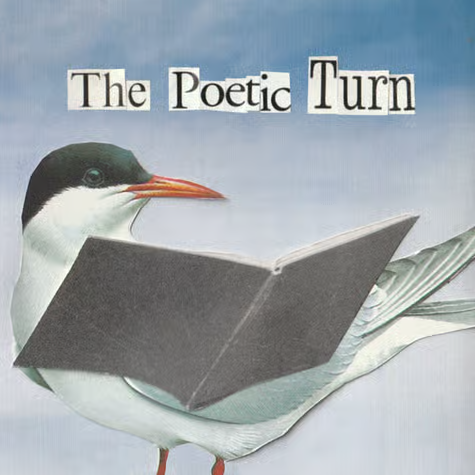
How cool is THIS?! My friend and former student Evan Carlson and Darren Stephens (actor, voice coach, and new friend!) have created a new podcast devoted to poetry and its structural turning–behold: The Poetic Turn Podcast!
It’s chock-full of great stuff! Here is the full list of episodes, which includes among its delights a consideration of Austin Smith’s wonderful “The Mummy in the Freeport Art Museum” and a conversation with poet Dan Smart, which, among other things, involves a discussion of his wonderful poem “How To Sing.”
Also included is a conversation with yours truly that focuses on the great turn in Joanne Diaz’s “Demeter’s Last Stand” (the text of which can be found here–just scroll down).
Fun stuff! Thank you, Evan and Darren, for extending the conversation about the poetic turn in such a rich and lively way!
Comments : 2 Comments »
Tags: Austin Smith, Dan Smart, Darren Stephens, Evan Carlson, Joanne Diaz, poetic structure, poetic turn, turn-to-another structure, volta
Categories : poetic turn, turn-to-another structure, Uncategorized, volta
Metamorphosis: Jorie Graham’s Transformative Turns
12 02 2026Just want to make sure that visitors to this blog know about this publication: “Metamorphosis: Jorie Graham’s Transformative Turns.”
I’ve written informally about Graham and the turn on this blog. “Metamorphosis” offers a more formal treatment of this connection and goes in-depth to show how deeply Graham and her work are invested in the turn.
Here’s an abstract of the article:
The poetic turn—a significant shift in the rhetorical and/or dramatic trajectory of a poem—is a considerably under-recognized aspect of poetry. Despite being a crucial element in the working of so many poems, no large-scale critical conversation on the turn, such as a monograph or a collection of essays, exists. Despite its supposed innovations, the criticism of and about hybrid poetry has done little to change this. While many accomplished poets, including a number of hybrid poets, are alert to the structural dynamics of their poems—that is, they are aware of and significantly engage turns in their work—hybrid poet Jorie Graham is relatively unique in that her poetics and poems foreground turns to an extent and in ways that few others do. Specifically, Graham tropes the turn so that it represents even as it enacts transformative power. Such troping is at work in much of Graham’s oeuvre; however, it reveals itself especially clearly in her most recent collection, To 2040, in which the turn itself becomes one more natural, if sublime, element that is being lost to the ravages of unremitting environmental degradation. In To 2040, the turn becomes a hopeless craning—“we feel our soul turn frantic/in us, craning this way and that”—a desperate gesture that is ultimately empty as it has no safe place to land, no alternative position on which to rest or from which to relaunch. This powerful, if frightening, trajectory in Graham’s work can be difficult to recognize, especially given hybridity’s continued missing of the turn, but it is important to see: doing so can help to recenter the turn in discussions about poetry while also leading to an improved comprehension of Graham’s prophetic, apocalyptic vision.
Comments : 1 Comment »
Tags: Jorie Graham, poetic structure, poetic turn, volta
Categories : Theory & Criticism
 Structure & Surprise